Happy International Book Lover’s Day! This seems like the perfect intersection to talk about our favourite things – animal tales, books, cats (International Cat Day was yesterday) and translated fiction by women (a month long celebration)!
Now, you’ve probably seen them everywhere- books with cats on them welcoming you into a bookshop, a night library, a regular library, a convenience store by the sea, a cafe (of the pottery or full-moon or time travelling variety) or a restaurant of sorts. There has been a boom in translated works, namely from Japanese and Korean authors, that feature ‘cats’ on the cover and a promise of “cosy fiction.” The majority of the books I’ve read where the cats actually play a central role are in Japanese translated literature, dubbed “Japanese Cat Lit.”
Background on “Healing” and “Cosy” Literature
Before I defend myself from the crazy-cat lady accusations, let’s backtrack. This rise in “cosy” literature comes from something we can all resonate with- storytelling that heals us and helps us understand the society around us. Michelle Cho, an associate professor in East Asian Studies at the University of Toronto, dubs it the “aesthetic of comfort” and while I agree, I think these episodic explorations of comfort also come from our drive to confront our own deep-rooted criticisms of society and win.
These slice-of-life stories often have a protagonist or multiple protagonists dealing with the rigorous expectations arbitrarily placed on them. Men, women and children are burnt out, left behind, struggling to breathe in an effort to stay in the rat race. There is a suffocating feeling in some of the books that intensely demands to be felt and it is this feeling that is essential to this genre. That feeling of not being alone- it’s okay, there are others out there struggling too. That there is a way through and to better things. That there is a way past grief.
Books like Hyunam-Dong Bookshop by Hwang Bo-reum simply shows us a woman starting again and pursuing her dreams even if it’s unconventional and not the established route to success. Convenience Store Woman by Sayaka Murata does this as well but with the backdrop of a liminal space where others are coming and going. On the surface these are ‘healing’ books, but peel back their layers and you will find intense social criticism. To delve further into this topic, I recommend Nina Culley’s “The Aggressive Commodification of Cosy Asian Fiction.”
Cats in Storytelling and Folklore
Back to the cats! Cat yokai are especially interesting because people saw cats with their glowing eyes doing odd things like stretching up to old Japanese lanterns and came up with all kinds of supernatural explanations for their behaviour. Cats and the supernatural have always been closely linked (see witches) and honestly, it all comes down to just how plain weird they are. We have a more in-depth exploration of Cat Yokai in our episode: Yokai Yocat based on the interview with Uncanny Japan’s Thersa Matsuura.
Now not all books with a cat on the cover actually feature felines at the centre. Some only feature the visual cat as a guide to welcome you into the story, but yesterday was international cat day so we wanted to look at the ones that actually use the cats. To muddy the waters even more, in some of the books the cat is just a cat, but in others there is magical realism and the cats come to life! August also happens to be Women in Translation Month, so we will be especially highlighting some fantastic Japanese women to start!

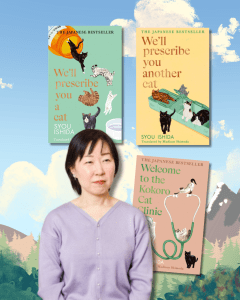
The Kokoro Cat Clinic Series by Syou Ishida
Translated by E. Madison Shimoda.
When you are lost, the Kokoro Clinic for the Soul will find for you, but not in the way you expected. Instead of giving you medication, Dr. Nikké has an unconventional method- he’ll “Prescribe You a Cat” and sometimes maybe even “Prescribe You Another Cat” if the first doesn’t work.
This episodic anthology has three parts with the next instalment coming out September 2026 and each short story features a character in need. By taking care of their cat and providing for them, the characters deal with their trauma and emotions, oftentimes getting to the roots of their problems.
There is an overarching story involving Dr.Nikké’s mysterious clinic, but we’ll let you discover that for yourselves.
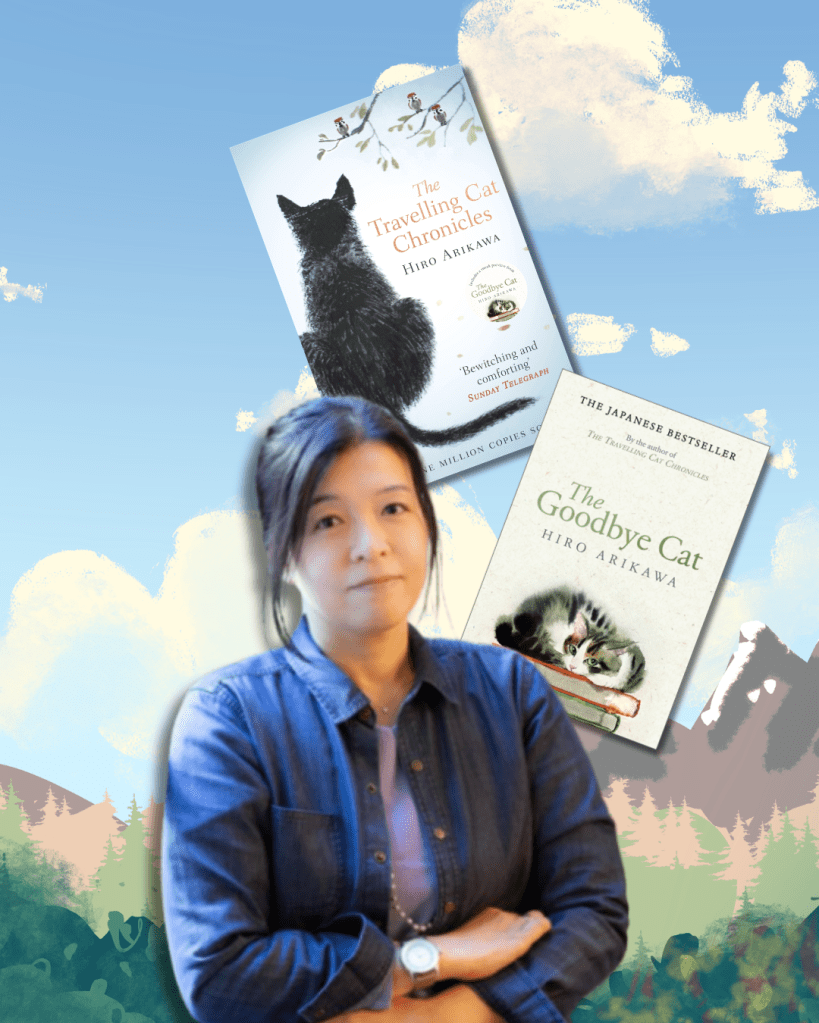
The Travelling Cat Chronicles and The Goodbye Cat by Hiro Arikawa
Translated by Philip Gabriel.
Hiro Arikawa’s “Travelling Cat Chronicles” follows Satoru Miyawaki, the stray cat he took in named Nana and the journey they take both physically and spiritually into Satoru’s past to find Nana a new home. Told in both perspectives, this was a heartbreaking read and will make you want to hold your cat and friends tight.
The spin-off, “The Goodbye Cat,” was more episodic with seven stories about seven cats and their masters. My favourite one was the title story with an old cat attempting to become a nekomata (a Japanese cat spirit). Each story is its own and as a collection, it is short and sweet.

The Full Moon Coffee Shop Series by Mai Mochizuki
Translated by Jesse Kirkwood.
“The Full Moon Coffee Shop” is our bridge into the magical realism world with a cafe full of astrology, giant yōkai-like cats and mystical storytelling.
Different (but often connected) down-on-their-luck, tired of life, lonely and lost characters suddenly find themselves in the cafe where cats read their astrology-sign charts and give them advice on what comes next. Pulling from western astrology (Grecian constellation/ star stories like Aquarius, Cancer etc.) and eastern with references to their time of birth and past lives, each visitor to the cafe gets a reading and understanding of how to move forward in life. I was not especially enamoured by the star-charts and wished there was more background to the characters, but it was a fun read!

The Cat who Saved Books Series by Sosuke Natsukawa
Translated by Louise Heal Kawai.
Don’t be fooled by the charming ‘cosy’ covers, Tiger the tabby cat is on a full-scale mission in defense of books, reading and publications. There is startling apt criticism of so many issues with current day ‘reading’ and ‘book’ culture- namely trophy books, speed-reading, mass-production, bans, censorship, destruction of old books…the list goes on and on. Personifying the issues in a magical-realism type of way made them into almost comic-book like bad guys that needed to be reasoned with.
The second-hand bookstore ‘proprietor’ of the first book is Rintaro Natsuki and the sequel follows Nanami Kosaki as they join Tiger on his missions.

Meals to Remember at the Chibineko Kitchen by Yuta Takahashi
Translated by Cat Anderson.
“The Curious Kitten at the Chibineko Kitchen” and “The Calico Cat at the Chibineko Kitchen” ask the question of if you could have one last meal with a loved one, what would you have and what would you say? The kitchen offers “remembrance meals‘ but unlike typical ones, rumours say you can actually see your loved one just until the meal gets cold. The only proof that you aren’t hallucinating? The kitten seems to also see the spirits.
Tender and soft, this book reminded me how memory lives in the foods we eat and how a simple meal can make us feel closer to those we lost.
If it was up to me, this list would go on and on, but sadly while there are a plethora of books centered around healing that feature cats, these are simply the ones I’ve read that heavily feature cats.
Special mentions include:
“She and Her Cat” by Makoto Shinkai and Naruki Nagakawa as translated by Ginny Tapley Takemori
A short story collection of various women finding a cat via the cat-distribution-system just when it’s needed.
“The Kamogawa Food Detectives” by Hisashi Kashiwai as translated by Jesse Kirkwood
Episodic collection featuring a father-daughter duo who help recreate memorable meals for their patrons. The cat is only tangentially related to the main storylines as a frequent patron of the restaurants storefront and adversary to the father.
The Vanishing Cherry Blossom Bookshop by Takuya Asakura as translated by Yuka Maeno
Another episodic collection based around the seasons where the owner of the mysterious Cherry Blossom Bookshop, Sakura and her cat Kobako, help those who are lost find themselves again in books from their past.
I haven’t personally read “Guest Cat” by Takashi Hiraide as translated by Eric Selland or “If Cats Disappeared from the World by Genki Kawamura as translated by Eric Selland, but they are on my list!
The only book in this genre that I read that I did not get something out of, was unfortunately “The Blanket Cats” by Kiyoshi Shigematsu as translated by Jesse Kirkwood. Normally when you have a short story collection, you can find one or two that resonate with you even if the whole collection doesn’t. It might also come down to liking the premise but not the execution. This was the first book where I felt every character was evil or cruel in some way and animal-cruelty is simply not something I want to read. Everyone was unpleasant and learned nothing about themselves or society. The idea of the ‘blanket’ cat was also unexplored and lost its potential.