Shad Raouf Qazaz on his debut novel “Children of the Zagros”
Debut author Shad Raouf Qazaz joins us to talk about his book, “Children of the Zagros,” Kurdish folklore, keeping myths alive and writing from the diaspora.
His novel can now be found in English, Dutch and Kurdish.
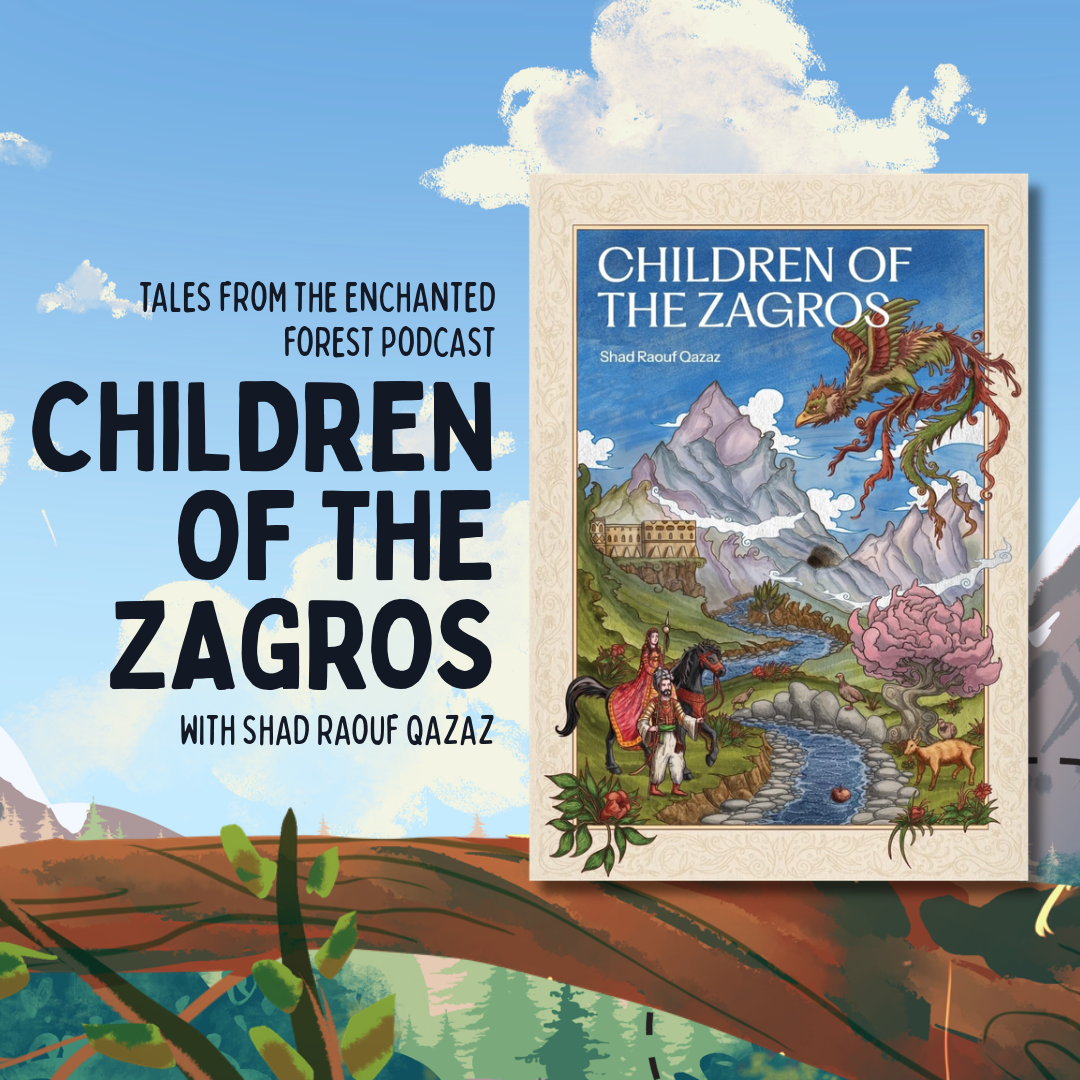
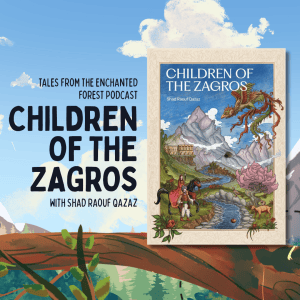
We were thrilled to be joined by Shad Raouf Qazaz, debut author of the novel Children of the Zagros. Originally written in Dutch and now translated into both English and Kurdish, the book follows Princess Runak as she defies her fate and learns what it means to be her people’s leader. Accompanied by a lone warrior, she turns from the crown to face a landscape where the wisdom of the Simurgh and the secrets of the Shahmaran are not legends, but living forces.
The story is a nesting doll that weaves Kurdish oral history, storytelling, literary traditions and other regional tales into a story about the people of the Zagros mountain.
We were lucky enough to get a review copy, but if you’re interested, then you can buy your own copy here!
Please note that this is an edited transcript of the full audio interview and dialogue has been condensed/edited in areas for clarity.
Researching Kurdish Folklore
Fox: So, this story was originally written in Dutch, and now we have the English translation, and you’ve spoken a little bit on other formats, other platforms, about how writing in Dutch came with its drawbacks, and naturally, as someone who also grew up speaking my mother tongue of Persian, and now I don’t actually know how to read it or write it,
I know that it’s really frustrating to do research into our own folklore when translations don’t really exist.
So, for you, what was your research process like as a writer trying to uncover these Kurdish stories, especially when you had to then translate it into Dutch and English?
Yeah, so, to touch on writing in Dutch. Dutch is basically my number one language. That’s the language I’m most proficient in. English is starting to become more proficient, but still, it’s Dutch. And Kurdish is a language that I’ve tried very hard to become better at, but it’s not a natural language for me, especially when it comes to reading and writing.
So, conversationally, I’m fine at it, but when it comes to reading, it becomes a very tedious process. Which does not make research more fun than it already is. So I did start out with looking for Kurdish books, but it’s not easy to find online, and this was also the COVID period where I was doing research, and I was coming down with some illnesses at that time. So I was kind of confined to the laptop screen…I did manage to find a lot of translations, although…there’s also another difficulty within this field of work, and that is that most folklore is written for an oral format.
And as you might have noticed in your own life, if you read out a song lyric, just the text, it doesn’t hit as it does on the song, and it’s the same for oral stories. So when you read them, usually…it doesn’t always hit the way it’s supposed to hit when it’s spoken.
So, I also had to think about how to translate back something that… has gone from oral to dry text, to something that is literally interesting as literature, so it’s not being spoken. So, both the language and the format was a challenge.
Fox: I was gonna say, growing up within a culture, you do know some of the nuances of what makes sense and what doesn’t, so when you read something or you hear something for example a lot of the times when I’m reading translated works, I’m like, “well, that’s not quite what I think they mean, but I think they’ve taken the literal translation…
Yeah, so touching on that point, that’s a very interesting thing to say. To maybe speak on the process, then…what I did do is kind of strip those tales, as I was reading them, from the decorative parts of it, and stripped them down to just the events. [Like] what is actually happening in that story? And then rebuild the style of speaking, the moral kind of lessons, or as you say, you know [taking] from your culture, I know how my uncles tell a story, I know how my aunts tell a story, I know how they respond. So, I kind of was able to put that flavor back in there, I hope, but in a literature sense .
So I think that’s a very important thing. Stripping the thing back, the story down to the events, to the plot, let’s say, and then rebuilding them back again with your own cultural contextual knowledge.
Fox: It’s like a puzzle, isn’t it? Like, you have to take the pieces that make sense, then build it up.
Yeah, it’s definitely a puzzle, and it’s also a puzzle because [w]hen you’re reading a folktale, it might give off the idea of the lesson that you draw from it being very logical, but actually it’s not. You can take a folktale in any kind of direction and give it any kind of moral lesson that you want. So the puzzle as well is to make it interesting to our current issues or things that we are dealing with while staying true to its character.
Storytelling between Cultures
Fox: So, how was that process for you to try and [to find] balance as well, because you have a Western audience, and as this book gets translated, it’s going to meet more audiences. How do you kind of balance what you wrote with this idea that your audience won’t just be Kurdish people, it’s going to be a whole group of people who might be seeing Kurdish traditions for the first time. How do you kind of balance that responsibility?
I think there have been points where I was debating how to do one or the other thing. But most of it flowed very naturally. I think because I am naturally a person that is between those two cultures and who has seen both cultures from the inside. I can argue from both cultures. And that is kind of something I like to do.
There was one conversation I had a long time ago with a corporate anthropologist, and…he said culture is a response to a problem. It’s an answer to a problem and that kinda shaped my idea of how to approach cultures or things that I do not agree with. What is the problem that is being solved? Now, this does not mean that the solution is not a totally wrong solution. It’s not humane to do something like that.
So the balancing is something, because [of] the contexts I’ve grown up in, the kind of understanding I have, the balancing, I feel like, came naturally.
…And..really one of the aims that I have with this book is to open people to a new kind of possibility. And there’s definitely a lot of things that are not explained, or shown or, you know, delved as deep into as you could. Especially some of the folklore and some of the mythology I’ve changed. I’ve made a decision to change the contents.
Coming back to your previous question, there’s also something universal with our culturally charged personal issues. You know, the question of reconciling with your past. The question of, what is my responsibility? The question of, who am I?
All of these are universal questions. You know, I’m in Amsterdam, I live in Amsterdam, which is the capital of the Netherlands. But people that come from the east of the country, which is, like, 2 hours away, who come to Amsterdam, they feel like they are strangers here.
So, if that small amount of difference makes you feel like a stranger in a country [then] the question of not being rooted in the place you are, that’s just a universal thing.
And one way that issue takes hold is, is as a Kurd, because you don’t have your own country. As a kurd in the diaspora because you don’t live there. As a child of a family who has some kind of expectations that you don’t have of yourself.
So those things are all universal, and if you watch it from a universal lens, then the Kurdish parts of it can also be one way to flavor it, one way to decorate it, one way to give it its shape.
Runak and Representation
Fox: So I think the book itself is a story of a girl. To me, it was a story of a girl who’s trying to discover who she is. It’s a story of a girl who’s trying to figure out her role in life, her position in life, and I think I could have just related to that on its own because the central part is Runak trying to figure out, does she want this?
Does she want to live this life? And then everything else, I mean, you could just let it be fantasy. And so, I think the universal elements of it are there. It’s a universal story of a girl who wants to figure out her place in life, and she has family commitments, and she has obligations to people.And I think that the universal part of it translates really well, because you don’t need to know the extra stuff to understand the story itself. It’s just the overall… it’s the hero’s journey in a way. Like, she’s going on this quest to figure out her role.
And the story is very ambitious. It starts when she’s young, her childhood, and then you see her grow up, and I think that part of it, seeing her go from a girl to a woman, That part of it is… it translates really well into a universal frame.
That’s great to hear from a woman herself. Because as a man writing a woman, you know, you have some questions, like, am I getting the experience right? Am I not? Am I not projecting?
A lot of stuff flowed by itself when I was writing, but one of the decisions, really, I made early on was that I didn’t want the main relationship to be a romantic one. You know? Because we’re talking about underrepresentation. It is an underrepresentation of male and female relationships that are not related, and that are not romantic. [The representation] is very little.
Sparrow: I was gonna say, anytime we find a story that is around, like, either just friends, or, like a brother and sister that are not trying to kill each other. I get so excited. Sometimes we’re like, yeah, the brother kinda still sucks, or the sister sucks, but they don’t hate each other. Isn’t this wonderful?
Yeah, thank you. Um, touching on Runak and her brother, [so] his name is Rezan. Which means respectable. His name translates to “respectable.” By the way, Akam, his name translates to “a good ending.” Runak means light.
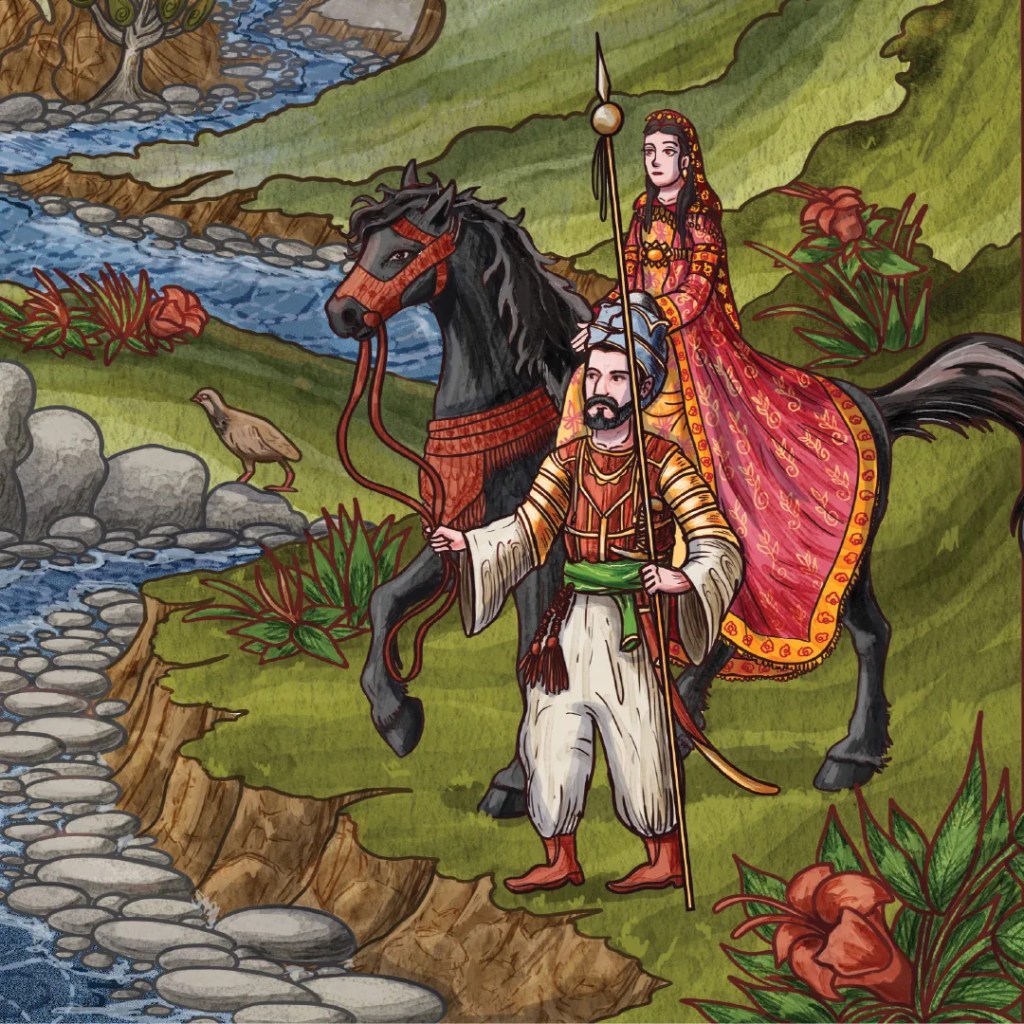
And I’ll talk about the translation of her name with the Kurdish part, after this one, because Rezan is the respectable one, so he does everything that is in the respectable way. He’s kind of her opposite. He does everything the right way. So, if the father decides this- he follows, he doesn’t care. He cares, but he follows. He always does. So that shows what is seen as respectable, or what is a respectable thing to do within this culture.
And even though there’s a moment where it almost turns into a fight amongst themselves, that is also a respectable thing to do, because you can’t let someone trample on your honor. Because, once again, coming from a tribal context where there is no higher judicial place, tit-for-tat is the only way that you can get justice.
Anyway, [back to] Runak. Translating Runak to Kurdish was troublesome, because the book speaks a lot about light itself, like, light is a very big theme. And I didn’t want to say Runak and light. Because it is just saying Runak and Runak.
“Runak said this in the Runaki way”- it doesn’t flow like that. So we went through sentence by sentence, finding different ways to say Runak, without using the usual Runak words.
So this is really where my father was very instrumental in this, because his grasp of Kurdish is very strong. He’s also an author himself, he doesn’t write fiction, he writes non-fiction. So, he translated it, but even, like, adapting it to what I wanted, he was very instrumental at that, in that. And I know we succeeded in it because one of our proofreaders, who is himself, a Professor in Kurdish…He told us, this book does not read like it’s translated. It reads like it’s written for Kurdish. So that was, like, one of the biggest compliments we had about the translation in Kurdish.
Translating Kurdish Heritage: A Family Affair
Fox: Speaking of your dad, I know that you’ve said before that he was an inspiration. How is this as a bonding experience with him to talk about your heritage, your culture, your folklore? Was that kind of something that you guys did that brought you guys closer together, or how did that process look for the two of you?
Well, I mean, I’m very close with my dad, so if I say it didn’t bring us closer together, that’s not a negative thing. Like, we’re close, but the interesting thing is, my dad has learned a lot from this book. Because he’s writing non-fiction and he is focused on history…So, although he has also written more abstract philosophy works, he is actually not interested in fiction. He doesn’t read fiction. He doesn’t like it, it takes too long, that’s what he always says. I need somebody to make their point in three sentences, not in 3 chapters.
But he said, I read your book from front-to-back in one go. So actually, he learned a lot of stuff about Kurdish folklore and mythology- more than he already knew.
Folktales and their Shenanigans
Sparrow: I want to go back to speaking of Rezan, because one of my favorite elements of the novel is how it feels like a fairy tale. We’ve kind of talked about that a lot, but it really does. Especially the way the characters communicate with each other through fables.
I love the moment when Runak’s brother tells her the story of the man who went to wake his luck even though Runak clearly had no patience for it. Were there other traditional folk tales that you wanted to weave into their conversations that didn’t make the final cut? Or do you have a personal favorite folktale from Kurdish folklore?
It’s always hard to say what is mythology and what is folklore. So, you know, that’s a decision. But really, “The Man that Went to Find his Luck” really is one of my favorites, because there are a lot of elements of Kurdish folklore that come together in that. That is…
That is talking animals, repetition, some sexism, unfortunately, with the Sultan. And, this kind of cheesy life lesson that you get at the end. But, you can imagine that when this is told, how fun it is to listen to. And that really is one of my favorites, because it’s very exemplary of what folklore is. It’s also funny! There’s a laugh at the end.
One other story that if I could go back, I would try to fit it in there, but there was just no way to get it right. And that is the story of Mem û Zîn, which is the Kurdish Romeo and Juliet. It’s a very big story.
There’s also a lot of people saying Romeo and Juliet is inspired by Mem û Zîn, but I have no idea whether that is true or not, but it’s a very similar story of two young people falling in love, not being able to reach each other.
One of them dies and the other commits suicide. That’s the plot. Now, there are thousands of versions of this story each with their own focus, each with their own connotations. Some are focused on nationalism, some are focused on religious teachings, some are focused on folklory kind of stuff. It has been used as a foundational nationalistic idea of storytelling.
Mythological Mayhem
Sparrow: Your book is also full of beings like Peris, Dews, Shamaran and the Simurgh….While researching or writing Children of the Zagros, was there a particular mythical creature you encountered for the very first time, or even, a well-known figure that you uncovered, a surprising new lore about?
We’ve covered these creatures before in our series on the Shahnameh, namely Zal’s meeting with the Simurgh and Rostam’s fight with the Devs. Check those episodes out as well!
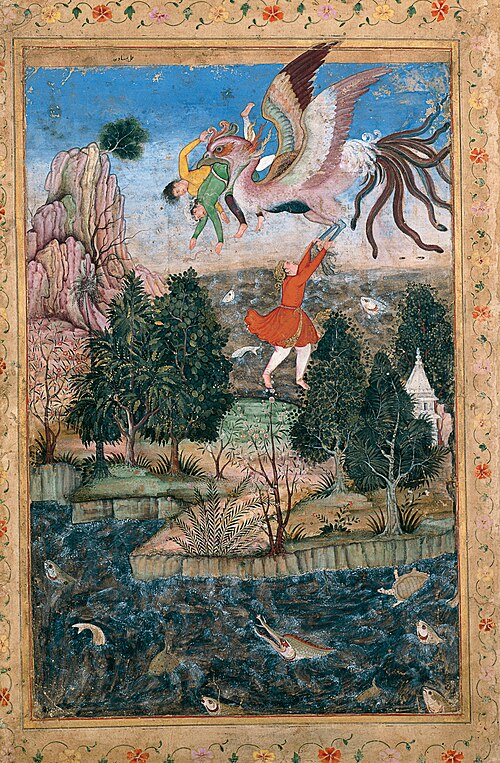
The Flight of the Simurgh. ca. 1590, Sadruddin Aga Khan Collection by Basawan – Self-scanned, Public Domain,
I read a lot of different stories about the Simurgh. Some by Western authors, some later on. That was really a story that struck me. This creature, which is kind of like a phoenix, but it’s not a Phoenix. That is responsible for fertilizing the world. Also, whenever authors write [about] this higher being within the works, it’s basically just a translation of what they believe.
I really felt like I didn’t do that, but when I read back, I kind of felt embarrassed, thinking, wow, this is actually just what I think is true. The Simurgh is saying a lot of things that I believe are true. Not everything, but as an author, I’ve projected my own beliefs onto a mythological being. But I really loved the Simurgh. I love the Shamaran as well.
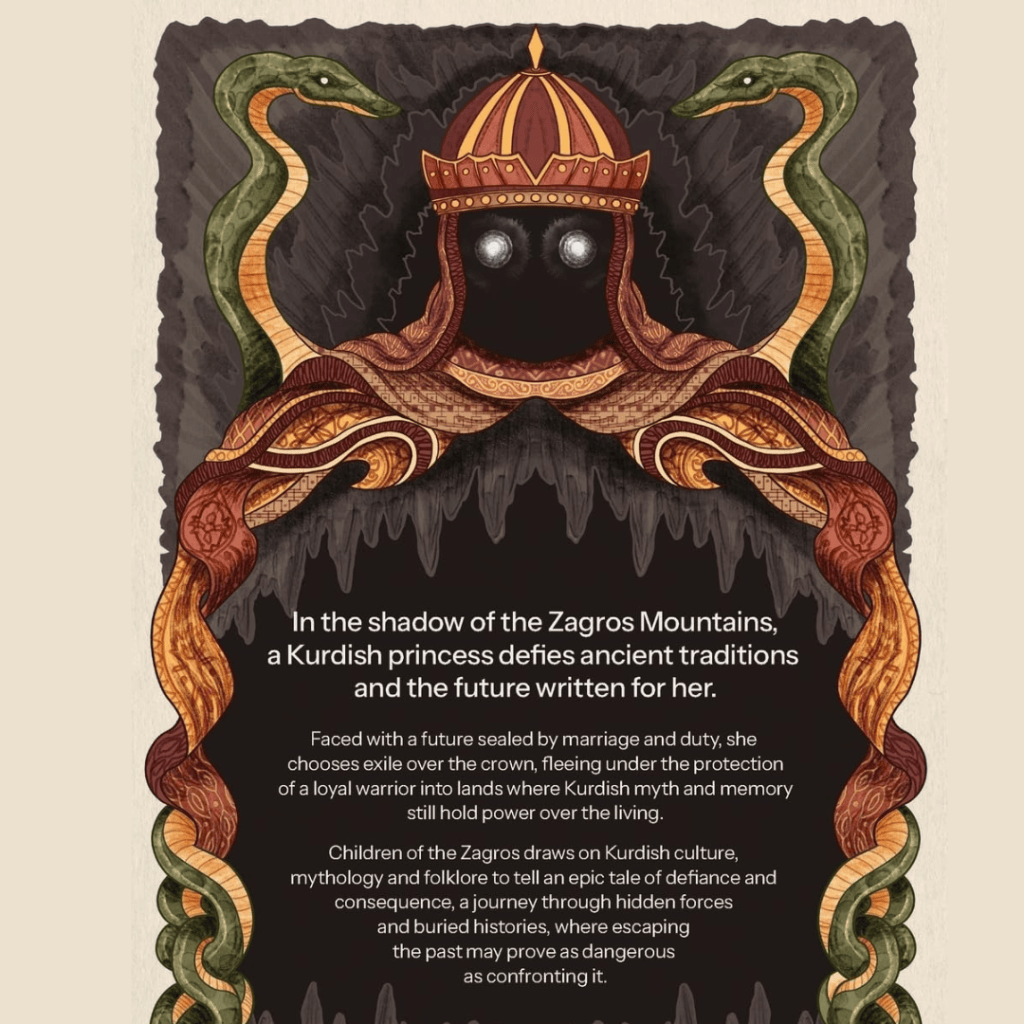
Also, I loved Zahhak as well. In the book, he’s called Zahhak, in Persian, it’s Zahāk and in Kurdish we say Zohak. I really liked him as a character as well because you can interpret him in many ways.
I believe he [is a] stand in. If you go very back to the mountains, the winter is a very harsh place [where] young children will die. It’s not the way it is now. So, in a lot of Kurdish regions, we have a 40-day period, which is called Rashamê, which means the black days. These are 40 days that are the blackest of the winter. You don’t want to leave your house in those 40 days. That’s how harsh winter can be and the defeat of Zahhak is the coming of spring.
So, he stands for winter, but you can also interpret him, culturally, as the oppressive culture that kills childlike wonder or innocence with its demands. And so the versatility of that character was one of the reasons I really enjoyed him.
Kawa, Zahhak and Evolving Storytelling Traditions
Fox: Specifically with this story, towards the end, we have Zahhak, and we have the legend of Kawa the blacksmith. And he’s kind of this big folk hero, and I had no idea of anything [related to] him, so after reading the book, I did some research on how he’s tied in a little bit more with Nowrooz, the celebration for Spring. How Kawa kind of represents this rising up and taking control of your destiny, no matter who you are, right? Because he’s just a blacksmith, but he [also becomes] this leader.
So, I kind of wanted to know, did the spirit of Kawa’s rebellion influence the way that you wrote Princess Runak, and her refusal to accept her fate, or did it come the other way? How did it work?
To read about Kawa and the story of Newroz, read it here.
Yeah, I really love that question and that’s why I like talking about this book with people who have read it with thoughtful questions, because that is a parallel I did not draw at all. At least not consciously.
But if you think about it, just as Kawa didn’t accept the demands of the king. Runak didn’t accept the demands of the king. She left and came back, and then at last, she took over. And she brought on a new era, [and] kawa does the same thing.
So, thank you for the parallel. I hadn’t drawn it myself at first, so maybe, definitely, she was inspired by Kawa in that way, just not consciously.
…Speaking some more on Kawa- So the story of Zahhak comes back in Sharaf al-Din Bitlisi’s Şerefname, which is a retelling of Kurdish history. It comes back in Shahnameh, which is Ferdowsi’s epic. It comes back in Zoroastrian books in the Avesta. All with different connotations, and since they all had changes, I decided to also make some changes.
And, in the Shahnameh, Kurds are the children that were saved from Zahhak’s reach, and after a thousand years, they come back and defeat Zahhak together with Kawa. Now, my question was, what happened in those thousand years?
[There are many versions of the Shahnameh that are not Fewdowsi’s epic, namely a famous 18th century version of the Shahnameh in Gorani could have been written by the Kurdish poet Sarhang Almas Khan.]
What if I write the Shahnameh or take inspiration from it, but take it from the Kurdish perspective. And start from there. That’s kind of what I did, and I’ve gotten criticism from Kurds, and I’ll probably get it from Persians as well, because I made some changes in the story. [Changes] that people on both sides of the aisle might not like.
In a lot of stories, Kawa has occurred, so a lot of Kurds have grown up with Kawa being a Kurd and defeating the evil king. In my book, he’s not a Kurd, he’s just from somewhere else, so it’s somebody else. But in Shahnameh, it’s Fereydun, the chosen king of Iran that kills Zahhak– or is at least in the fight with Zahhak. And I’ve actually relegated him to a few sentences. He’s just mentioned a few times. I’ve kind of, like, written him out of the story because I have my own objectives in telling the story and I made that choice very deliberately.
It’s the thing about identifying so strongly with one version that leaves no room for variety or difference, but you have to remember, like, if you want to keep your story alive [and] living then it will change, and even if the words stay the same, the interpretation 100 years later will be different, because people relate what they read to their current contexts.
So yeah, stories change, that’s how they stay alive, and obviously, we can talk about making certain decisions and whether they were good decisions, or whether the story becomes better or worse. Those are, I think, fair things to talk about and criticize as well, if needs may be. But the fact that you should not change one iota of a story, that is a… I think that’s a lost cause.
Living the Story: Experiencing the Zagros Mountains
Fox: There was so much geography in this book! We saw your videos on Facebook of you traveling to some of these places, and they looked phenomenal.
That to me, was living folklore. You researched the folklore, you wrote a book about it, and then you went to these places. So, how did it kind of feel for you to travel to these places after writing about them? Did you have… feel like you had a connection to them? Did it feel different?
So definitely, a lot of the places I had already visited. There were some specific places where I hadn’t gone, and some places I still can’t go because of military occupations in those regions.
[But] visiting those places, really the one that was most striking and which I hadn’t visited yet before was Shanidar Cave itself. I had planned to visit all those places when writing, actually, but as I said, it was during COVID and I had come down with an illness, so I wasn’t able to, unfortunately, see everything I wanted to see before finishing the writing. But going to Shanidar Cave was amazing because there’s a passage when the king and Runak go to Shanidar Cave and they go stand in the big opening, and they walk through a small area into a hidden cavern within the cave.
I just thought of that as a way of portraying the dark cave of the soul, like, if you look at the hero’s journey, we’re going deeper into the mystery. But it turns out that the cavern is actually there in Shanader.I wrote it, but I didn’t know it was there. It actually exists. We went into the cabin, I was like, wow, oh my god this place actually exists, I didn’t know it’s actually there. And it’s a small little hole, like, you have to crouch for 10 meters or so until you get in there. So, that was one of the most amazing things to see, that was actually based on facts, even though I didn’t know it was there.
Homecoming
Sparrow: Alright, finally, this book has now been translated into Kurdish. How does it feel to see the book finally make it home and just come full circle? We’ve talked a bit about this, but I want to know how it feels.
Amazing because I went back…to promote the Kurdish translation. We were in a hall, and there were 100- 130 people [and] I was stooped. I had no idea it was like that, or people were gonna be coming. I was kind of afraid people would be like, what is this diaspora kid trying to talk about? One of their passion projects, again.
But people really loved it. And what they also really enjoyed was somebody who is not living in Kurdistan themselves, but still having these good stories and Kurdish culture dear to their hearts, that’s what what they love seeing. And for me, it was great.
Yeah, how do I describe it? It really felt like homecoming, and it felt like being accepted back into the tribe. They were like, you are one of us, like, you might have left, but you’re still one of us.
What’s the other language that’s being translated into?
So, in Kurdish, we have multiple languages, or dialects, I should call them dialects. So, the two biggest ones are Sorani and Kurmanji. It’s [been] translated to Sorani…[and] I also want to translate it to Kurmanji, and that’s what we’re working on right now.
And for me, it’s very important that it exists in the languages Kurds speak, so they can actually read it in their own language, yeah.
To see the full interview, including what the author would choose to ask the legendary Simurgh then be sure to check out the full podcast episode!
You can also order your own copy of the book on https://childrenofzagros.com/
Disclaimer: Tales from the Enchanted Forest received free review copies of the book. All statements, opinions and copyrights belong to their respected owners.