How the rabbit lost its tail
Brazil, 11 minute read
This explanatory tale comes just in time for Spring and all things Easter. Did you know Rabbits used to have long tails? To find out how they ended up with just a tuft, be sure to listen to the episode or read the notes below!
I’m sure you’re all gearing up to grab your Easter baskets, chocolates and, for some, preparing for your Easter festivals! In central Europe, our town centers are all decorated for Osterfest, while the Canadian supermarkets are bursting with their chocolate displays. And, of course, somewhere in England, children are preparing to crack their massive chocolate eggs open with their heads.
All this talk of bunnies has us thinking of bunny folklore and folktales. Rabbits often hop into many animal tales, usually taking on the role of the quick and reckless character or the trickster archetype. But today’s rabbit tale doesn’t fall into either of these categories. Instead, we get more of an explanatory tale similar to ones we’ve covered in the past like the Nigerian tale of “Why the Elephant has Small Eyes” and the Australian story of the “Rainbow Serpent.”
Our other animal tales include ones with animal companions, tricksters and much more:
- The Cottager and his Cat: An Icelandic Fairy Tale
- Aesop’s Fables
- Puss in Boots
- The Butterfly’s Wedding: A Highland Tale
- Nigerian Animal Tales
- The Mitten: A Ukrainian Tale
- Filipino Animal Tales
- The Jackal and the Spring: A South African Trickster
This Brazilian tale on “How the Rabbit Lost it’s Tail” comes to us from the book “Fairy Tales from Brazil: How and Why Tales from Brazilian Folk-tales” first published in 1917. The author, Elsie Spicer Eells, was an American researcher of folklore who lived from 1880 to 1963. She travelled a lot during the early twentieth century to many countries as a researcher for the Hispanic Society of America. As a result, she collected many oral folktales from Brazil and other parts of South America.
The Rabbit’s Tale
Once upon a time, rabbits used to have long tails, while cats had none at all. This did not sit well with our feline friend as the cat longed to have such a beautiful one of her own.
One night, when the rabbit slept without a care in the world, the cat, Mistress Puss, silently approached the defenseless rabbit. Making quick work with her knife, Mistress Puss cut off the rabbit’s tail in one strike. Remarkably, this didn’t immediately awaken the rabbit. The cat hastily began to sew the tail on, but right before she could finish, the rabbit finally awoke with a start. After an awkward amount of time, during which the rabbit and the cat stared at each other in this uncomfortable situation, the cat finally spoke.
“Doesn’t the tail look much better on me?” Mistress Puss purred.
“It does look very becoming on you, I must say,” the generous rabbit replied. He continued, “In fact that tail was too long for me anyways. So how about a trade? You can keep my tail, in exchange, you give me the sharp knife.”
Thinking herself quite clever, the cat agreed enthusiastically and handed the knife to the rabbit. And so the rabbit picked up his new knife and bounded into the forest. “I’ve lost my tail but I’ve gained a knife,” he said to himself. “I’ll get a new tail or something else just as good.”
The Basket-Weaver
And so, the Rabbit bounded through the forest for a long time. Eventually he came across a little old man making baskets out of rushes. He was skillfully weaving the baskets and the rabbit was mesmerized.
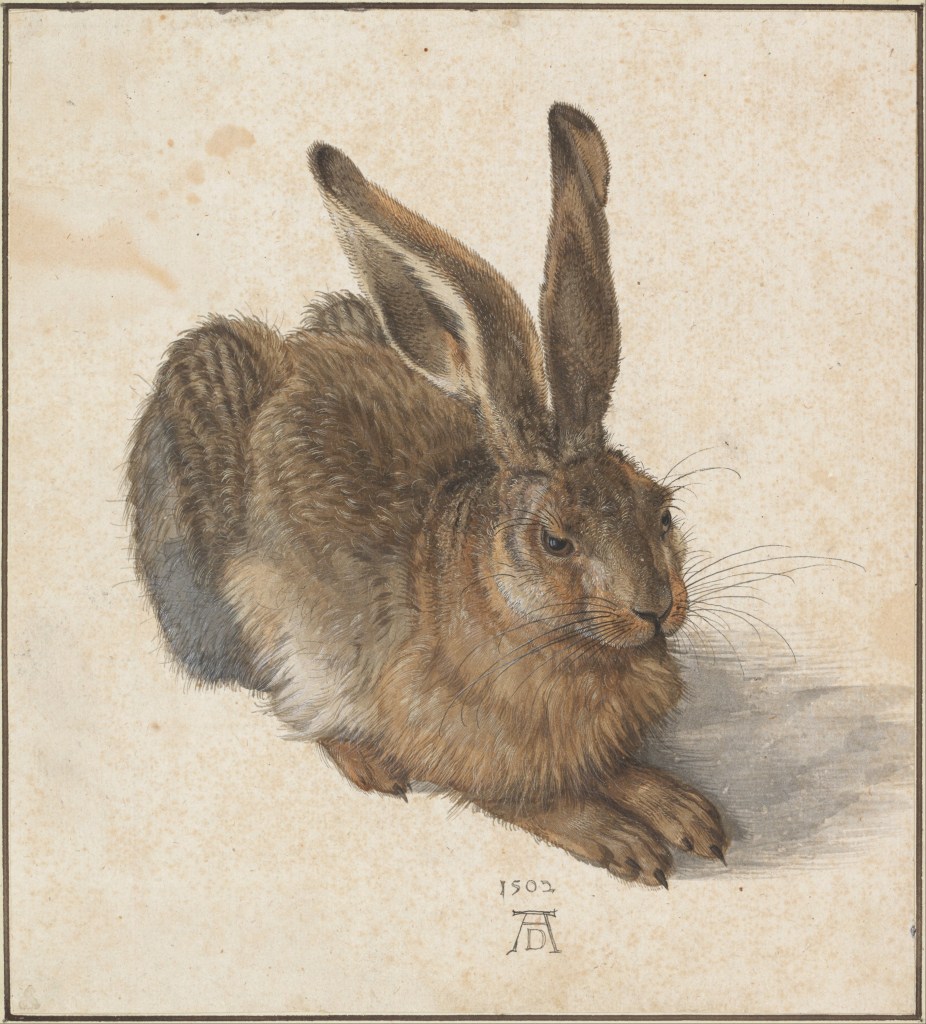
Painting by, Albrecht Dürer (1502)
However, the old man had no tools, so he had to bite the rushes off with his teeth. When the little old man saw the rabbit hopping along with a sharp knife, he asked if he could borrow it, for biting the rushes was very hard on his teeth.
The Rabbit agreed and handed over the knife. But as soon as the old man started to cut the rushes with it, the sharp knife snapped into two. Thankfully, nobody was hurt but that didn’t stop the Rabbit from panicking over his new knife.
The little old man profusely apologized to the rabbit as he did not mean to break it. The rabbit looked at him and said he had no use for a broken knife. But he thought the little old man may still be able to use it even in its broken state. So the Rabbit proposed a trade, the broken knife for one of the old man’s baskets.
The little old man agreed and handed a basket to the rabbit. With that, the Rabbit bounded off once more into the forest. “I lost my tail, but I gained a knife. I’ve lost my knife, but I’ve gained a basket,” he said to himself. “I’ll get a new tail or something else just as good.”
The Head of Lettuce
So, the Rabbit once again hopped along in the deep forest for a long time until he came to a clearing. There, he saw an old woman harvesting lettuce. She put what she could in her apron, but it filled up so quickly that she had to run back and forth in a huff. When she noticed the Rabbit hopping along with his basket, she quickly waved him down. She asked if she could borrow his basket to carry her lettuce.
The Rabbit agreed to this proposal, but as soon as the old woman plopped the first lettuce in the basket, the bottom gave way and broke apart. She began apologizing as the Rabbit cried over his broken basket. He recovered far quicker this time and explained to the old woman that he would exchange the broken basket for a head of lettuce. Now, maybe the old woman knew how to fix the basket, or she felt bad about the situation; either way, she agreed to this exchange.
With that, the rabbit hopped away with the lettuce in tow as he said to himself, “I lost my tail but I gained a knife. I lost my knife but I gained a basket. I lost my basket but I gained some lettuce.”
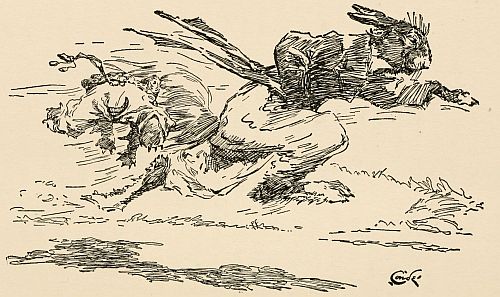
Illustration from “How Mr. Rabbit Lost his Tail” from Albert Bigelow Paine’s “Hollow Stories” as illustrated by J. M. Condé.
After his eventful morning, the rabbit soon became very hungry. The lettuce smelt crisp and fresh, so he took a small bite. With that one nibble, he knew this was the very best thing he had ever tasted in his entire life. As he continued eating the delicious lettuce, he said, “I don’t care if I lost my tail because today I found something I like a lot more.
From then on, no rabbit has ever had a tail, nor have they lamented the loss of one. Instead, there has never been a rabbit who did not love lettuce and who was not perfectly content with lots of it.
And that is why rabbits don’t have a tail.
Or at least that’s why they don’t have long, cat-like tails. If you notice, they still have a little tuft, which is helpful in confusing predators as they run in zigzagging patterns. Most rabbits have darker colours on the top part of their tails and white on the bottom which they use to signal others of predators. So, if you see the whites of a rabbit’s tail, its probably time to hop to it.