The Crystal Casket
Italian, 16 minute read
Enjoy Giuseppe Pitrè’s Tuscan tale with us as we dive into the Eagle revenge story of the century. This story has fairies, a Witch who is frankly bad at her job, an evil stepmother, a casket obsessed King and his bewildered mother! Oh and our Snow White character, Ermellina! Who may or may not be twelve years old.

This Tuscan tale comes to us from the 1883 book Italian Popular Tales. The collector, Thomas Fredrick Cane, was an American academic and lawyer who was passionate about languages, medieval history and folklore. While working as a professor at Cornell University, he wrote and co-wrote many articles and books about primarily medieval folklore and cultural history. Despite not being Italian, he was passionate about their stories and wanted to make them accessible to English speakers. His Italian Popular Tales not only features a wide range of stories, but also includes an extensive bibliography to understanding the origins of the tales.
The story is translated from the La Scatola di Cristallo raccolta by Giuseppe Pitrè. An Italian version of the tale can be read here. It follows the Aarne-Thompson-Uther type 709 classified as the “Snow White” Stories which include: the Grimm Brother’s “Little Snow White,” Joseph Jacobs’ “Snow White,” Kenneth Macleod’s “Golden Tree and Silver Tree,” Giambattista Basile’s “The Young Slave,” Laura Gonzenbach’s “Maria, the wicked Stepmother and the seven Robbers.”
Cane’s collection also includes a charming tale called “Snow-White-Fire-Red,” however, this falls more into a Rapunzel tale type than the classic Snow White stories.
Given that this is a Snow White story, you might be guessing where the story will go, but I assure you that it is different from what you’d expect. Just look below at some wide ranging Snow White adaptations including one heading to theaters March 21, 2025!





The Origins of an Evil Stepmother
There was a time when a widower lived with his young daughter. The young girl never knew her mother, as in classic fairy tale fashion, the mother passed away when she was quite little. But life must go on, and eventually, when she came of age, the young girl’s father sent her to school. When the teacher discovered that the little girl had no mother, she devised a plan to escape her situation as a spinster. The teacher told the young girl that she had fallen in love with her father and asked the young girl to discover if he would like her as a wife.
The teacher questioned, prodded and asked the young girl every day until she finally brought it up with her father. She told him that the schoolmistress would ask her every day if he would ever marry again. The father was surprised by this and warned his daughter that if he took another wife, it would only be trouble for her. Nevertheless, the daughter insisted, probably because she was tired of her teacher’s daily confrontation. Finally, he agreed to meet the schoolmistress at her home, and a few days after they met, they married. But it took no time for the school teacher to embody the evil Stepmother role.
As part of her new job as an evil Stepmother, she made the young girl go onto the terrace to water a basil plant daily. However, this terrace wasn’t the sturdiest and was very high above a large river. Falling off of it meant certain death.
The Eagle’s Revenge
One day, a large Eagle flew by and saw the young girl crying on the terrace. Curious, it came down and asked why she was crying. Weeping, she explained that she had to water her Stepmother’s basil plant. But she was afraid of falling from the high terrace. The Eagle told her to get on its back, and it would take her somewhere far away where she could be happy and not have to worry about her new mother or the basil plant.
Happy to get away from her Stepmother, she agreed. The girl carefully climbed onto the great bird’s back. The Eagle flew for a long time before eventually coming to a great green plain with a grand palace made entirely of crystals. The Eagle knocked on the door and said: “Come, open the door my ladies, for I have brought you a pretty girl!”. The ladies of the palace came out and were awed by how cute she was. The ladies were delighted to care for the young girl, and she was happy to be wanted.
You might think that the Eagle’s role in this story was finished given that she had brought the little girl to a palace where she could live happily ever after. However, this tale does not end here. The truth is, the Eagle’s real reason for helping the little girl was to get revenge on the Stepmother. For what?
Well, let us return to the Eagle who had returned to the terrace to see the Stepmother watering her basil plant. The Eagle asked her where her stepdaughter was. The woman shrugged and said she didn’t know. Perhaps the miserable little girl had fallen into the river below. The Eagle was annoyed that they did not get the reaction they wanted. The Eagle told her that it had seen how she mistreated the girl, so it brought her to live with his fairies, and she was doing very well. With that, the Eagle gleefully took off.
Wicked and Defying Pleasantries
Enraged, the Stepmother called on a Witch she knew in the city. She told the Witch that her stepdaughter was still alive- all thanks to this Eagle and his fairies. The Stepmother then asked the Witch to kill her stepdaughter. She was afraid that the girl would one day return, and then her husband would kill her for what she had done. The Witch reassured her that she would take care of everything.
Let us leave the witch to her plotting and return to the girl, whose name is revealed to be Ermellina. Maybe this is a new name she got from living with the fairies. Or perhaps it represents that she is growing up. Or maybe the original storytellers forgot to name her till just now. Either way, she has earned herself a name for the audience.
The fairies were bustling around as they readied to leave for a four-day trip. They told Ermellina not to open the door for anyone and to be extra cautious as her Stepmother might be up to something nefarious. She promised them she would not open the door and reassured them that her Stepmother had nothing to do with her anymore.
Of course, only a short time after the fairies left, there was a knock at the door. Ermellina “wisely” told the knocker that she would not open the door. The knocking only became more persistent, and eventually, her curiosity became too much, so she peeked out the window. She was surprised to see a servant girl from her father’s estate. The servant girl explained how her father was devastated because he thought she was dead. But then a large Eagle had arrived and told him Ermellina was alive and well with the fairies. He understood that she would want for nothing here, but he still wanted to send her a gift of sweetmeats and a letter.
The young girl struggled with this news and wrestled with herself. She wanted to uphold her promise to the fairies but was especially fond of sweetmeats. Surely, there could be no danger here? After all, she recognized the servant girl!
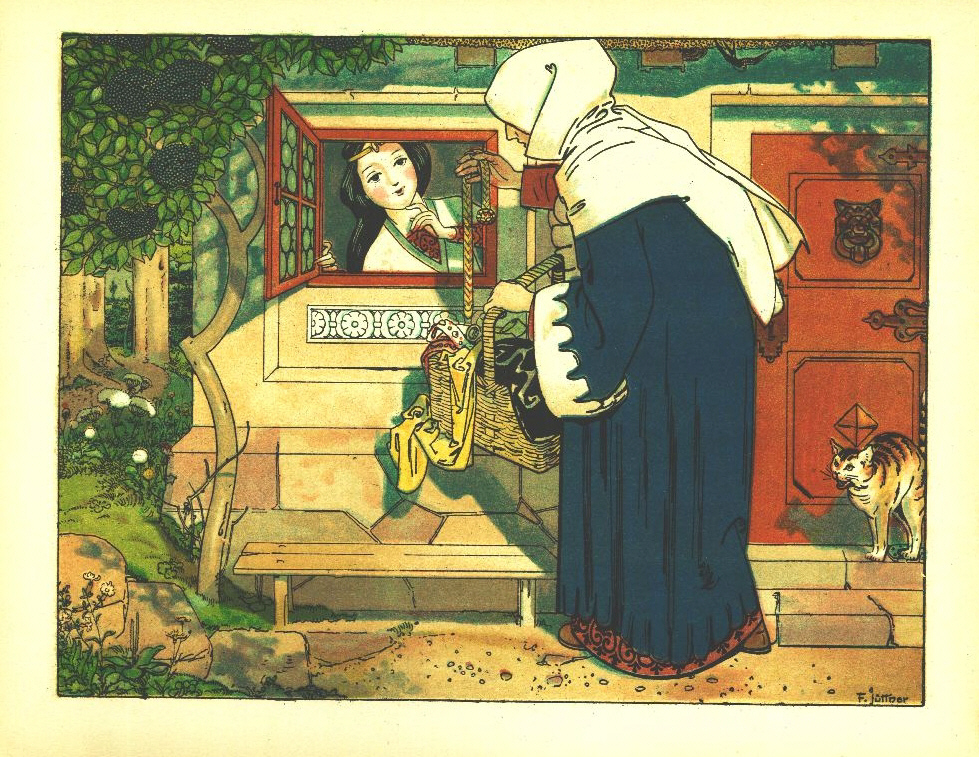
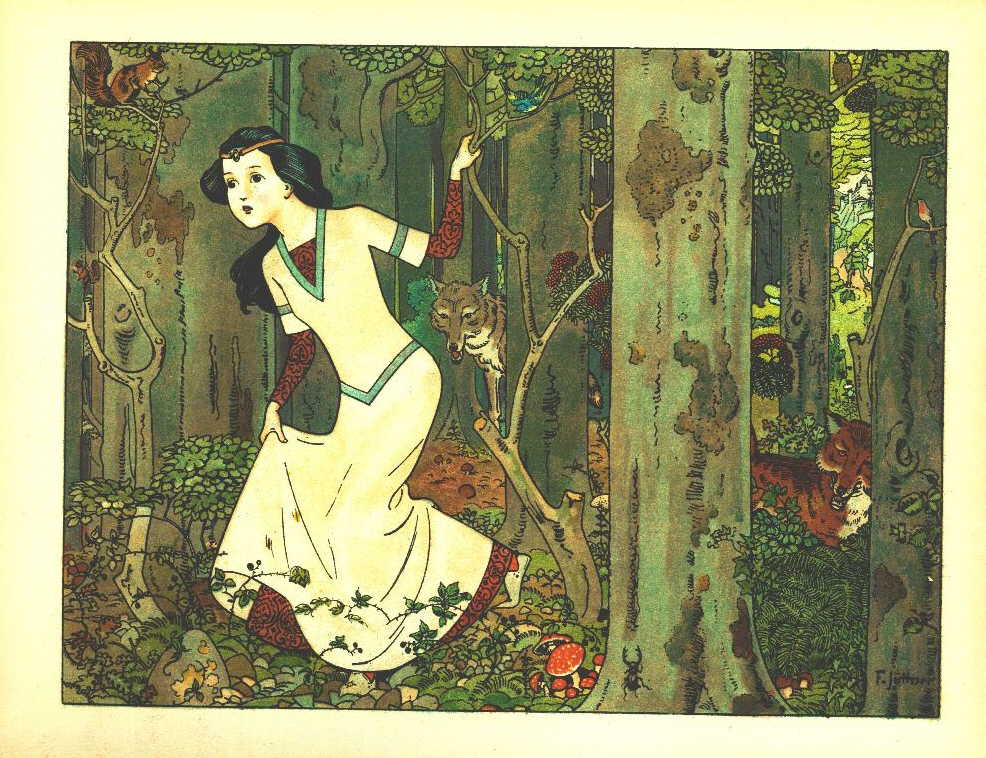
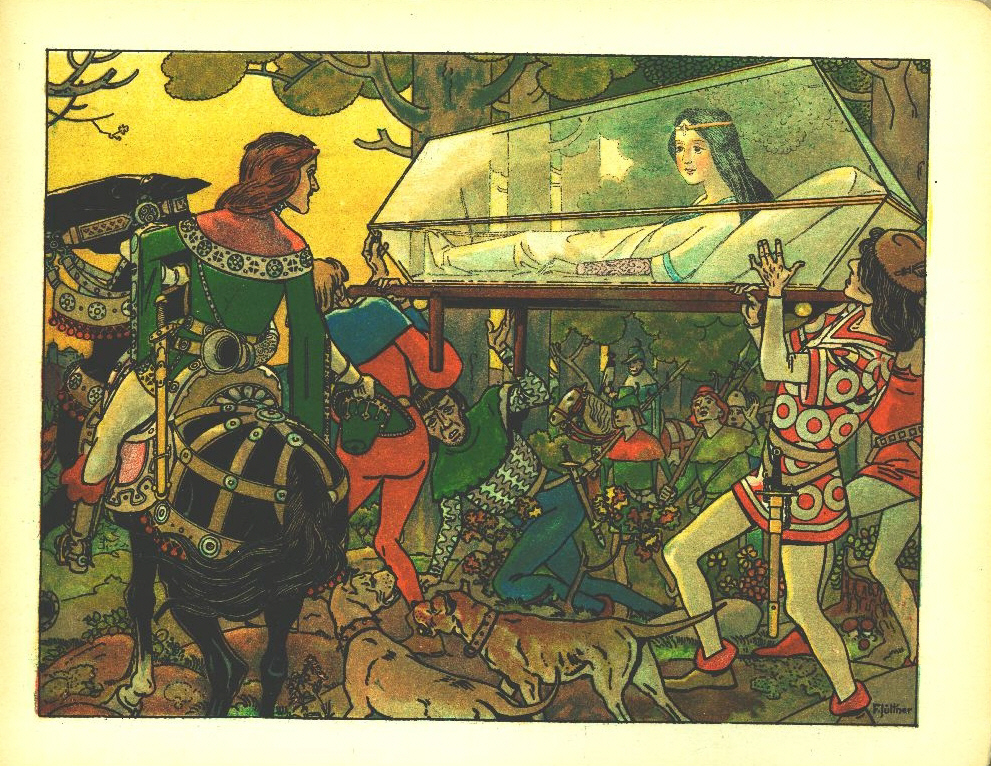
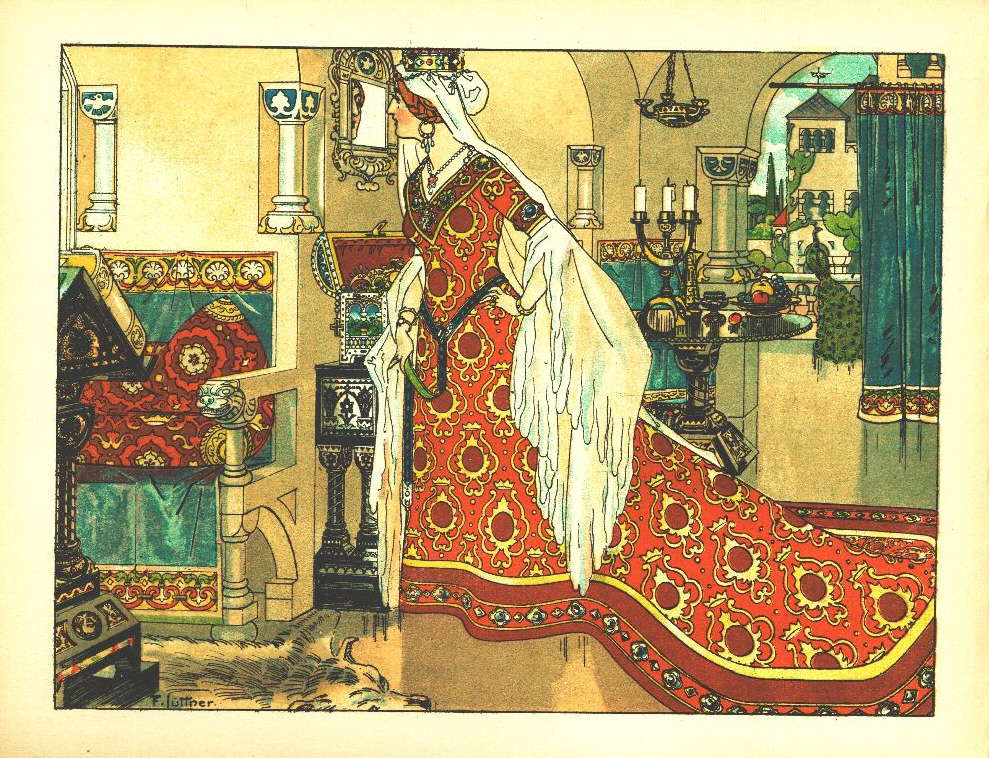
Franz Jüttner’s Sneewittchen
Resigned, she opened the door, and as she did, the servant girl shoved the basket and a piece of sweetmeat into Ermellina’s hands. As the young girl took an eager bite, the servant vanished into thin air. Before Ermellina could register what had happened, she collapsed onto the floor.
In a twist no one could have foreseen, the servant girl was really the Witch in disguise. Not only that, but the sweetmeats were poisoned!
Let us turn to the fairies, who, upon returning home, found their sweet Ermellina dead. They wept and wept, for what else could they do? All the fairies begged the Chief of fairies to bring her back to life, but she refused as Ermellina was disobedient in opening the door. Inconsolable, the fairies continued to plead for the young girl, and eventually, the Chief agreed. The Chief removed a piece of sweet meat from Ermellina’s throat, and life returned to her once more. The fairies were overjoyed to see their friend alive again, but the Chief warned her not to disobey ever again.
If at first you don’t succeed…
Soon, it was time for the fairies to journey once more. The Chief turned to Ermellina and reminded her of the promise. If she opened the door again, the Chief would have nothing to do with her. The young girl reassured them that she would certainly not let anyone in this time.
Let us turn back once more onto the Eagle who decided that now was the perfect time to torment the Stepmother again. Flying overhead until she saw her watering her basil plant, the Eagle swooped down and taunted her. She boasted that the wicked plan had failed, and Ermellina was alive and well with the fairies. The evil Stepmother called the Eagle a liar and chased her away, but the doubt had lodged in her heart. Feeling worried, she went to visit the Witch again and warned her that if the girl was truly not dead, then her ire would turn on the Witch instead.
The Witch ordered the Stepmother to buy the finest dress she could find and bring it back. Then, the Witch disguised herself as a Tailoress and headed to the Fairy house once more.
The Witch knocked on the fairy door. Ermellina was confused to see her Tailoress, but she called through the door that she had been deceived once and would not open the door again. The Tailoress could return when the fairies were home.
The Witch, as the Tailoress, pleaded with her. She said they knew each other, and she had travelled a long way to see her old friend and give her a dress as she had always done. How cruel to leave her stranded outside. Unfortunately, this plea worked, and Ermellina let her in. The Tailoress presented Ermellina with a gorgeous dress and begged her to try it.
However, as soon as the young girl buttoned herself into the beautiful dress, she turned to find that the Tailoress had vanished. Confused, Ermellina went looking upstairs, but as she reached the top step, the dress tripped her, and she tumbled down the stairs to her death.
When the fairies returned home, they were once again devastated to find Ermellina dead. They wept and wept, for they truly loved her. But the Chief reminded them that Ermellina had been warned not to let anyone in, yet she still did not listen. The Chief tapped her wand on Ermellina’s body, and a beautiful, ornate crystal casket covered in diamonds formed around her.
As a goodbye, the fairies made a garland of flowers and gold to place on the young girl before enclosing her in the casket. With a wave of her enchanted wand, the Chief of the fairies summoned a handsome horse and placed the casket on its back. She ordered the horse to run and not stop until someone called out to him, ‘Stop, for pity’s sake, for I have lost my horse for you.’
A Wild Horse Chase
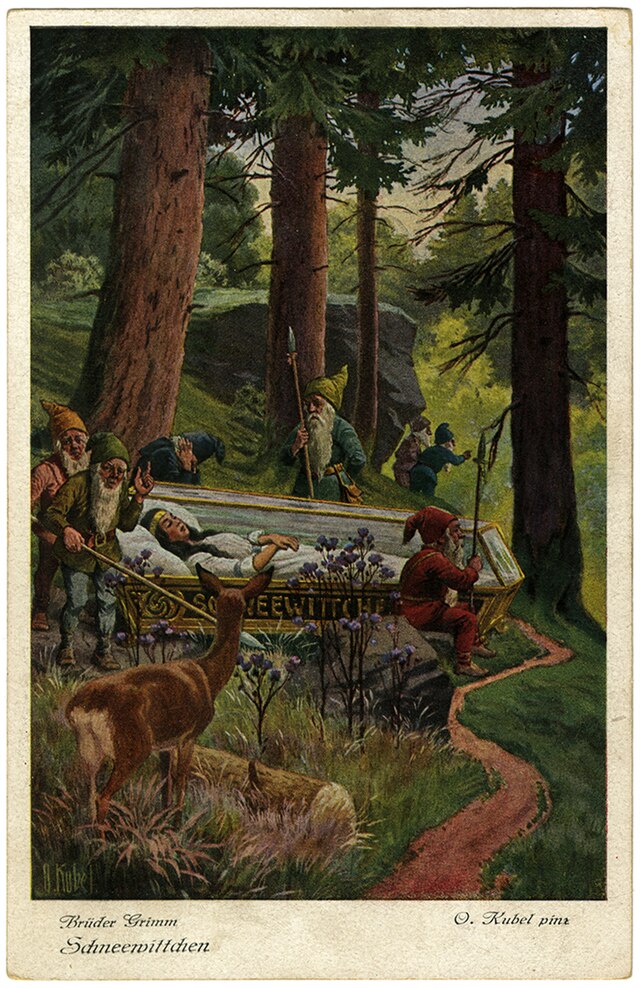
Now, we must leave the fairies in their pitiful state and follow the horse. Not long after departing, the horse passed a King. The King was shocked to see a riderless horse galloping away with something glittering on its back. So, he rode after the horse. However, he was so eager in his pursuit that he rode his horse to death. This did not stop the King, and he continued after the horse on foot, but he soon became worn and tired.
Snow White art by Otto Kubel
Eventually, he could endure it no longer and shouted, “Stop, for pity’s sake, for I have lost my horse for you.’ Hearing the secret phrase, the horse stopped. When the King caught up, he saw the beautiful dead girl in the casket and thought no more of his dead horse.
He took the horse and the casket back to his castle. Upon his return, his mother greeted him but was shocked to see what he returned with. He had gone on a hunt but had returned with a wife, or so he claimed.
The Dowager Queen was concerned. With her husband having passed some time ago, her son was the most powerful man in the land. Yet, here he was, referring to a woman in a casket as his new wife. She asked what it was. Was it a doll? A dead woman? But the King scoffed and said it was his wife. His mother let out a panicked laugh before leaving the room. For what else could she do?
After that, the King no longer went hunting. He didn’t do much of anything besides stay by the casket. Thankfully, this obsession did not last long because soon a rival kingdom declared war, and he was called to the battlefield. Before he left, he assigned his mother and her chambermaids to take care of the crystal casket. He warned them that if anything happened to her while he was away, he would execute anyone and everyone responsible. Bidding her perfectly sane son a warm goodbye, the Dowager Queen reassured him that they would take care of his…wife.
The King wept bitterly before he left for war. Even on the battlefield, he continued to write letters to his mother about his wife.
To Dust or not to Dust
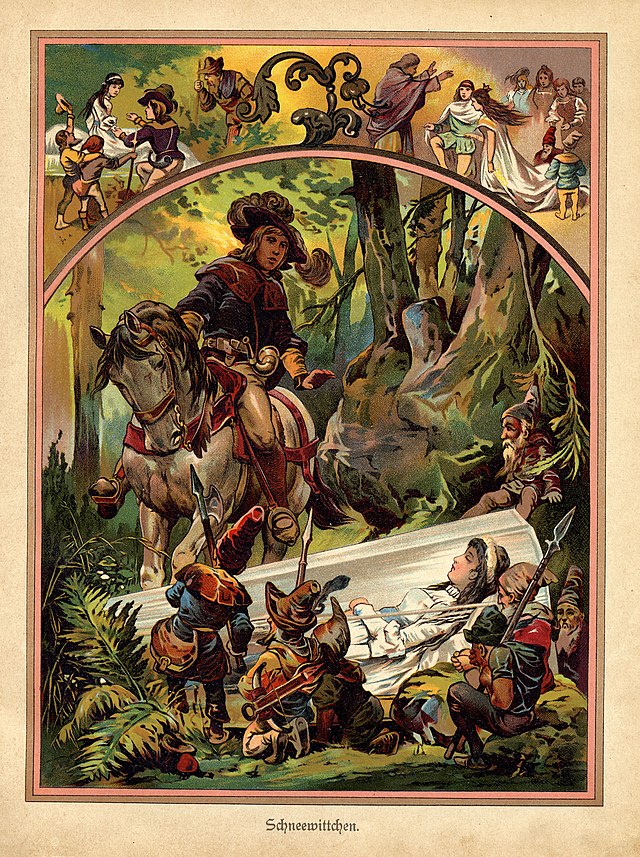
Let us return to the Dowager Queen, who had all but forgotten about the crystal casket and the dead woman inside of it. That is, until she received word that the King had won the war and would come home in a few days. She realized her grave mistake and quickly called the chambermaids to her side.
Art by Walter Zweigle for Märchenbuch, c1919.
They would all be ruined if her son returned to find his doll dusty. The maids were initially terrified when they stepped into the King’s room, but the girl in the casket was so serene that they truly thought she must have been a doll. No human would be able to remain so beautiful after death. Unfortunately, while cleaning her face and hands, some water spilled onto the dress, and the maids panicked. They remembered the King’s earlier threat and ran to the Dowager Queen for advice.
The Dowager Queen called for the royal tailor to replicate the dress as quickly as possible and ordered the maids to take the soiled dress off the girl. Not a second after the first sleeve was tugged off did Ermellina’s eyes flick open. Understandably, this was followed by a chorus of screams and panic.
Once the havoc settled, Ermellina explained what had happened to her. She teared up as she explained all that the fairies had done for her. The Dowager Queen filled her in on all that occurred while she was dead, including the bit about her obsessed son.
Before they could finish their conversation, trumpets sounded outside to announce the King’s victorious return. The Dowager Queen’s maids quickly dressed Ermellina in fine robes and had her hide in a small room. Rushing down to greet her son, the Dowager Queen found that the King had sidestepped all the fanfare and made a beeline towards his rooms. She tried to speak to him or slow him down, but to no avail.
Where is my wife?
When he entered his room, the King stood in unconcealed rage and horror at the sight of the empty casket. The chambermaids fell to their knees as they explained that they had no choice but to bury the body. It had decomposed terribly during his time away. The King did not care and called for the executioner to be summoned at once.
At this, the maids trembled and looked to the Dowager Queen with pleading eyes. Surely, she asked her belligerent son, surely he would not want a dead woman! He could have anyone he liked in the kingdom! He told her that he would not listen to reason. Dead or alive, she should have left it for him. So, at least he realizes how insane he was being.
Resigned, the Dowager Queen realized how serious her son was about the execution. She rang the little bell, and the not-dead girl stepped out of the side room.
The King was amazed and asked his mother to explain how his beloved was standing there! All the women took turns explaining everything that had happened.
He listened carefully and then proclaimed: “Mother, since I adored her when dead and called her my wife, now I mean her to be my wife in truth.” The Dowager Queen gave her blessing, and the happy couple married a few days later.
Now, let us turn back to the Eagle, the Stepmother and the fairies. Or not. The story does not tell us why the Eagle was so hellbent on tormenting the Stepmother or why the Stepmother was obsessed with watering her basil plant. Perhaps their bad blood is a tale saved for another time.
As the Tuscan storytellers say:
Se ne stettero e se la goderono
E a me nulla mi diedero
They stayed and enjoyed it and gave nothing to me.