
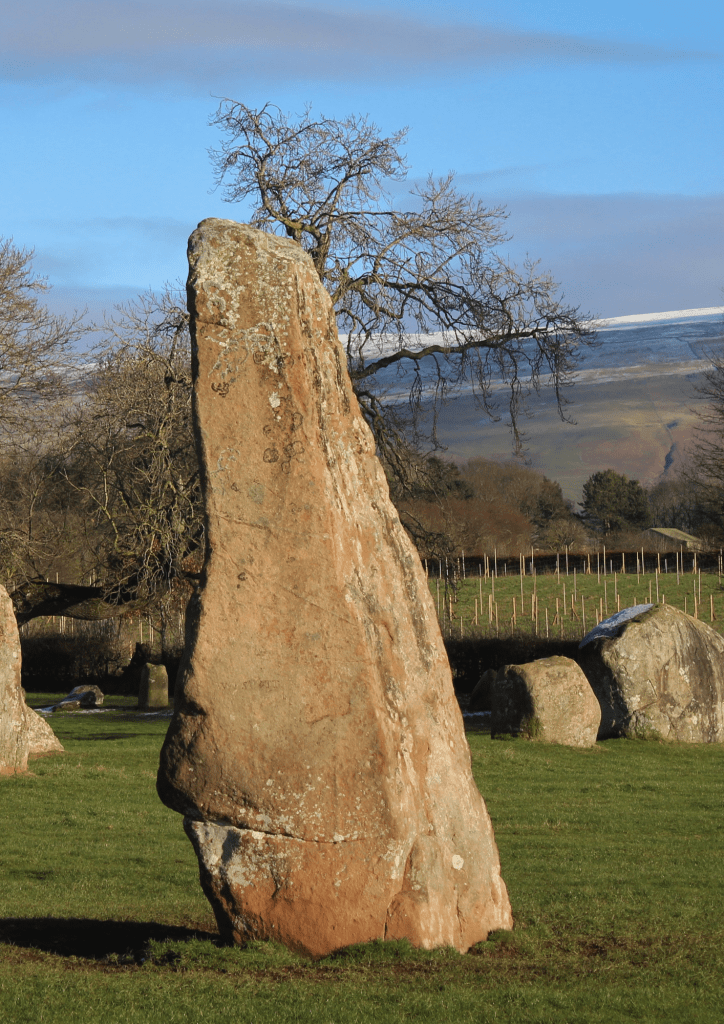
As summer comes to an end, we have a story from the summer solstice that we recounted last year. Our story delves into the history of one of Britain’s oldest and largest prehistoric stone circles, known as Long Meg and Her Daughters. Located near the village of Little Salkeld, there are 66 stones that form a circle, with the largest being slightly away from the others- this is Long Meg.
The folktale associated with the stones is tied to witches being turned to stone! This connection was first mentioned by the topographer William Camden in the 17th century and later expanded upon by historians such as Celia Fiennes and William Hutchinson. However, it wasn’t until the 1860s that Mackenzie Walcott introduced the connection to the wizard Michael Scot. Our retelling of the story comes from Cumbrian Folktales by storyteller Thomas Taffy.
Photograph by Chris Bickerton
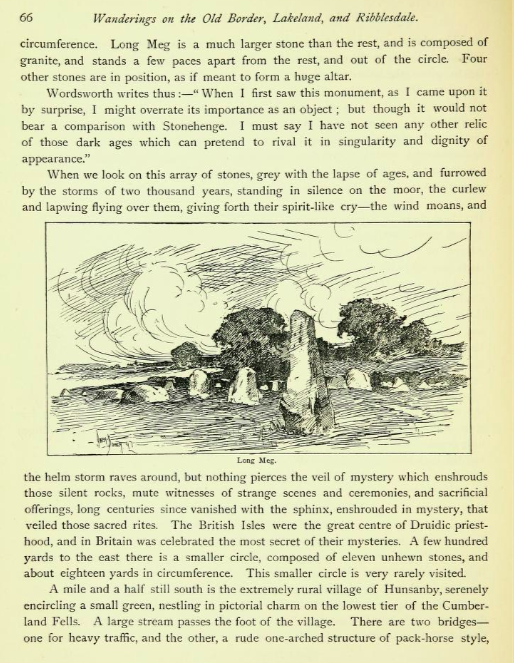
Some believe the rocks were at the centre of a holy place, others believe it was a drudic temple and more pragmatic people believe they were used to indicate the location of marshlands. With the intricate symbols carved onto Long Meg, it’s hard not to think of some magic being involved.
Among others, even the poet William Wordsworth was taken by the stones and their majesty.
To learn more about the stones:
StoneCircle.org
The Modern Antiquarian
Photogrammetric Survey of Long Meg
Cumbrian Folktales by Thomas Taffy
“A thousand miles of wandering along the Roman Wall, the old border region, Lakeland, and Ribblesdale” by Bogg, Edmund
Long Meg and her Coven
It was before my time, before your time, but at some point in history, there was a woman named Marget, known as Meg, who lived in the village of Salkeld. Everyone knew she practiced the old religion and raised her many daughters as part of her coven. The village priest was aware of the witches but left them alone, as long as they didn’t practice on the Sabbath. In England, the Sabbath wasn’t like the Jewish day of rest, which falls on Friday, but on Sunday, the Lord’s day. Meg respected the villagers and their religion, so it was a live-and-let-live situation.
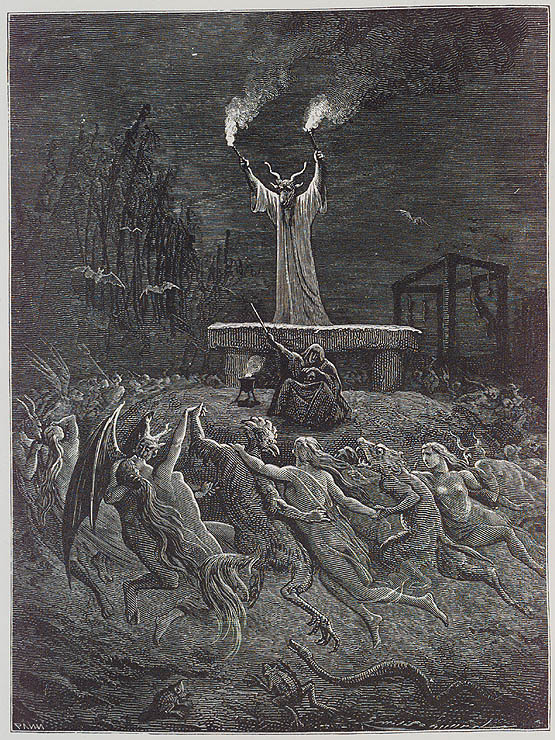
The witches celebrated on two significant days: Halloween and the Summer Solstice. Problems only ever arose if either of those days fell on a Saturday and the witches didn’t stop celebrating by midnight. Thankfully, Meg had always been careful and all was well.
Art by Émile Bayard
One summer, the priest anxiously noted that the Summer Solstice would fall on a Saturday. He took the time to visit Meg on the outskirts of the village and told her to finish their celebrations by midnight. Meg had lived peacefully in the village for years, so she was happy to reassure the priest. The only issue was that her daughters, now teenagers, were willful, moody, and prone to doing whatever they wanted. However, Meg promised to keep her daughters under control.
That Fateful Night
That night, Meg gathered her daughters as they prepared for the Summer Solstice. When she told them they had to stop dancing by midnight, her daughters roared with complaints. They argued bitterly but never came to a resolution. On the evening of the solstice, Meg and her daughters danced around a bonfire in an empty field above the village. They gathered plants and medicinal herbs, built sunwheels, and rolled them down the hill. As it neared thirty minutes before midnight, Meg paid the musicians and called for the last dance. The girls danced, and at the end of the song, they begrudgingly stopped.
However, disaster struck. As Meg and the musicians were heading down the hill, she spotted a stranger wearing a long black cloak and holding a fiddle. Had the wind blown his cloak aside, she would have noticed his cloven hooves, but she was tired and exhilarated from the celebrations. So, she continued down the hill and it was the worst mistake of her life. If Meg were here today, she would tell us so herself.
The stranger approached the girls, still gathered around the bonfire, and asked if they needed a musician to accompany their dance. Defiant and wild, the girls handed him a bag of gold and whooped with delight as they continued dancing. The fiddler played as though the very hounds of hell were at his heels. The cloven hooves hinted that this might have been the Devil himself, but…
Yer a Wizard, Michael Scot!
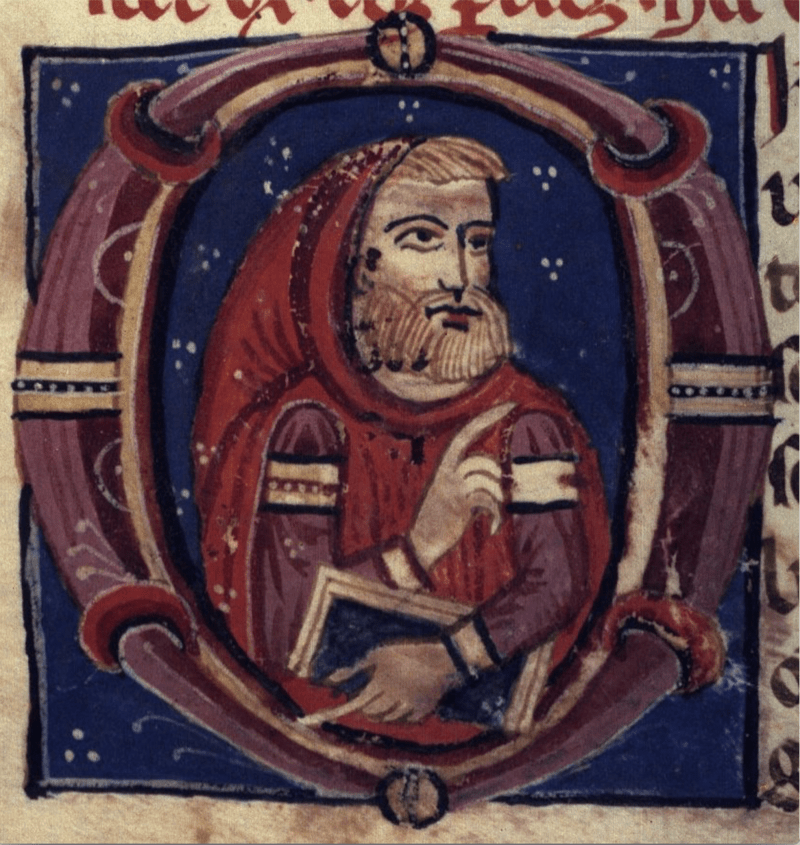
Michael Scot in Bodleian ” De physionomiae“, MS. Canon. Misc. 555, fol. 059r
In later stories, the fiddler is often attributed to the infamous wizard Michael Scot. Michael Scot was a real person—a scholar who traveled widely and even worked for the Holy Roman Emperor, Frederick II, as his astrologer and science advisor. He was a polyglot, interested in the occult, prophecy, and the future. He even appears in Dante’s Divine Comedy, in the Eighth Circle of Hell, alongside other scholars and false prophets who claimed they could see into the future.
In legends, he’s often depicted as a wizard, which may be because he favored wearing Arabic robes and could write in Hebrew and Arabic. It was also said that he changed the course of the River Tweed and split the Eildon Hills into three peaks.
Travellers, remember that the connection between the wizard and Long Meg wasn’t made until later in the legend, so his motivations and actions aren’t entirely clear.
Fiddler on the Hill
Either way, the fiddler played, and as he did, the girls danced and danced until the clock struck midnight. From down below, Meg heard the bells toll. Looking up the hill, she saw the silhouettes dance in and out of view. Frantic, she ran back up the hill to stop them, but it was too late.
In the church below, the priest watched in horror as the distant music continued, and the bells stopped tolling. He collapsed onto his knees in prayer, but just as he did, a flash of light boomed in the sky, and the dancers were turned to stone. This included Meg, who was just outside the circle, having been unable to save her daughters in time.
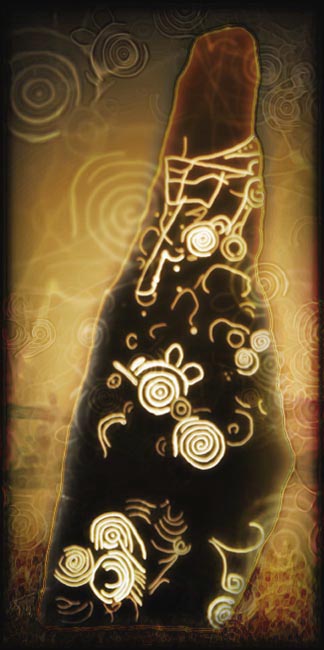
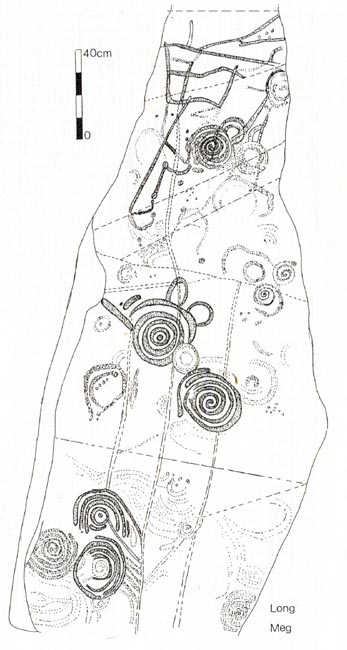
Images show some of the patterns on Long Meg from the Modern Antiquarian
Legends say that if you try to count the stones and end up with the same number twice, the stones will come to life and chase you down the hill.
Local folklore also recounts that in the 19th century, a landowner named Colonel Lacey tried to remove the inconvenience of the stones by ordering his men to blow them up. The workers placed kegs of black powder under each stone, but just as they lit the fuses, the clear sky suddenly broke into thunder and lightning. No one has dared remove the stones since.
That is our story of the summer solstice to end the summer season of the podcast. It was first released last year and can be heard here:




 Tales from the Enchanted Forest
