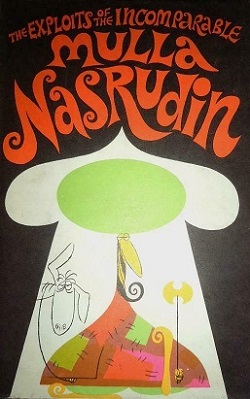
As many of our listeners know, the month of Ramadan is when Muslims worldwide fast and give thanks for all they have. Last year for Ramadan and Eid, we told the moral tales of the Wise Fool, a folk figure known as Mullah Nasruddin and now, following Eid al-Adha, we have our post!
Of course, this is just one of his names since his tales come from many different regions. In Turkey, for example, he is known as Nasreddin Hodja of Anatolia and is believed to have been a real historical figure from the Seljuk empire.
These stories are not usually tied to a single group or people but are part of a collective tradition. Given that the Seljuk Empire stretched from Turkey to India, it is clear that there were significant transmissions of the tale from East to West and vice versa.
Overall, there are thousands of stories about this character, and he is a central figure in the Muslim storytelling tradition, embraced by many groups including Turks, Persians, Indians, Uzbeks, Bengali’s, Albanians, Azerbaijanis, Indonesians, Arabs—the list truly goes on.
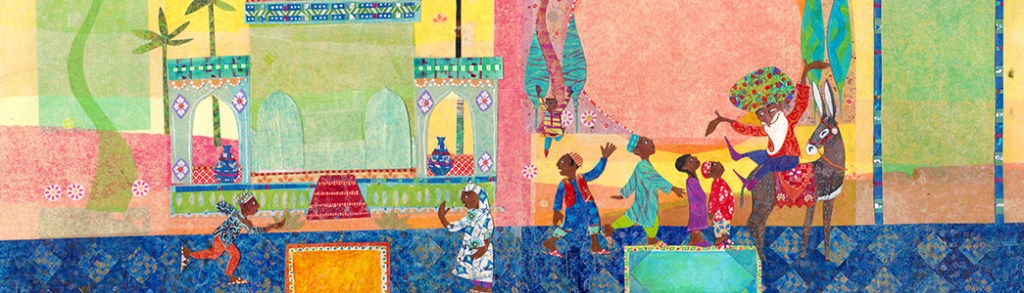
“The Wise Fool” written by Shahrukh Husain and illustrated by Micha Archer.
Typically, his name is made up of two parts: an honorific and his name. Different regions use different honorifics, and some of these terms are difficult to define precisely since their usage can be quite broad. However, to simplify, “Khoja” generally means master or lord, “Mullah” is an honorific title given to a religious leader, clergy member, or judge, and “Hajji” refers to someone who has completed the Hajj pilgrimage to Mecca. Ultimately, these titles serve to portray him as “wise.” He is not just a random man on the street; he is someone learned and of some importance who ends up playing the role of both the fool and the trickster.
The Sermon
Once there was, and once there wasn’t, and once there was Nasruddin, who was speaking in a new village. When he got to the pulpit, he looked around at the audience and asked: “Do you know what I’m going to say?
“No!” the people shouted.
Nasruddin replied, “How can I preach to people who have no idea what I will be talking about?” Then, he left.
The next day, the people called him back, feeling quite ashamed and embarrassed. He asked them again, “Do you know what I’m going to say?”
This time, they all shouted, “Yes!”
So Nasruddin replied, “Ah, since you all know what I will say, then I will not waste your time. We can all leave!”
This left the group even more perplexed than before, and so they invited him back one more time. When he asked the question again, half the group shouted “Yes,” while the other half shouted “No.”
Nasruddin packed up his things and bid them farewell, saying,
“Let those who know teach the half that don’t know.”
Then, he left the village.
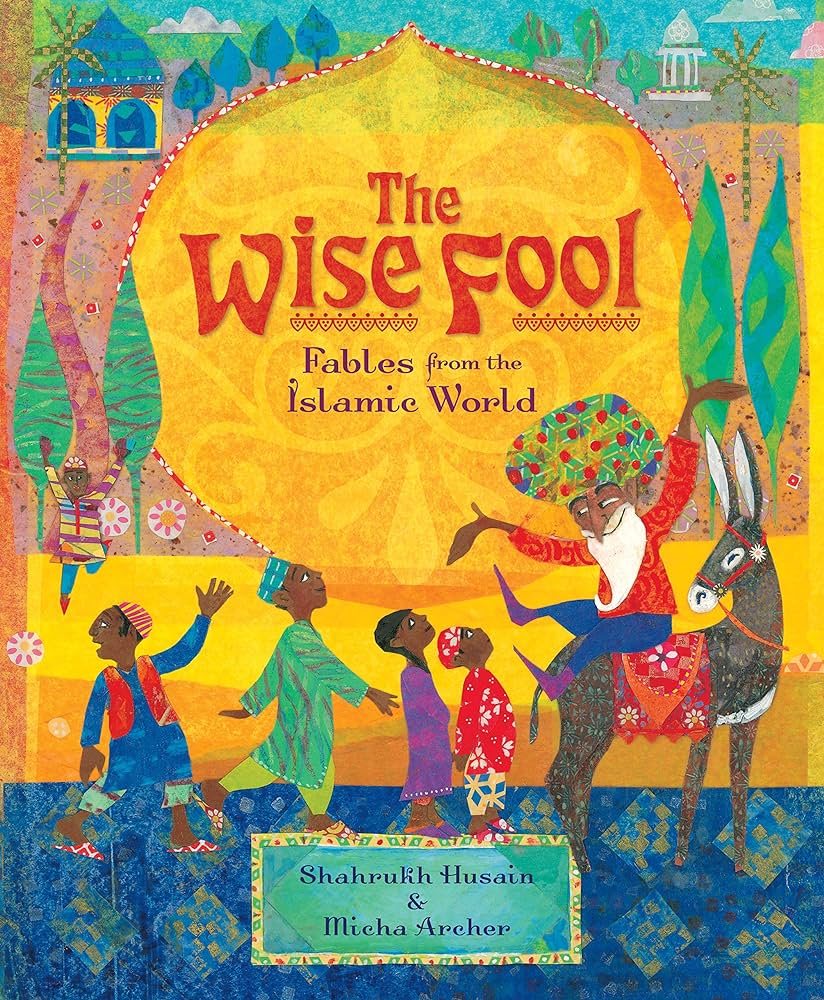
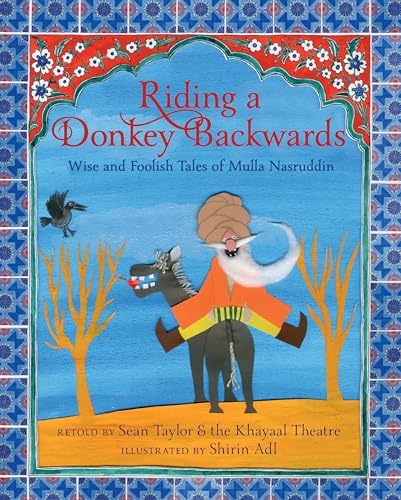
“The Wise Fool” written by Shahrukh Husain and illustrated by Micha Archer and “Riding a Donkey Backwards” illustrated by Shirin Adl.
Beastly Insults
That night, Nasruddin fought with his wife. Hearing their donkey braying loudly in its pen, his wife said, “Your father is calling you, go and see what he wants!”
Nasruddin left and returned a moment later with a cheerful grin.
“He asked me to tell you that your mother, the crow, sends her love.”
Camels and Men
The next day, Nasruddin’s neighbor came to his house and asked, “Which is more intelligent, a camel or a man?”
The Mullah looked over and replied, “A camel. It carries heavy loads without complaint but never asks for another load. Man, on the other hand, burdened by responsibility, is always choosing to add to his loads.”
Unexpected Visit
Later, Nasruddin decided to visit his friend spontaneously. The friend in question was upstairs and saw Nasruddin coming from the window. He called down to his wife to pretend that he wasn’t home!
When Nasruddin knocked on the door, the wife apologetically said that her husband was not home and had just stepped out.
Looking up, Nasruddin said that it was alright, but she should let her husband know that next time he leaves, he should remember to take his head with him instead of leaving it at the window.
The Poor Man in the Coffee House
On his way home, Nasruddin ran into a stranger looking desperate at a coffee shop. Curious, Nasruddin stopped and asked him what was wrong. The man began crying and said he used to be rich but lost everything, and soon he will have to beg on the streets! Nasreddin laughed and placed a reassuring hand on the man’s shoulder. He said, “Do not worry, you will not have to feel like this for long!”
The man was shocked and looked at Nasruddin in awe. “Do you mean I will become rich again?”
“Oh no,” Nasruddin said. “You’ll just get used to being poor.”
After Life
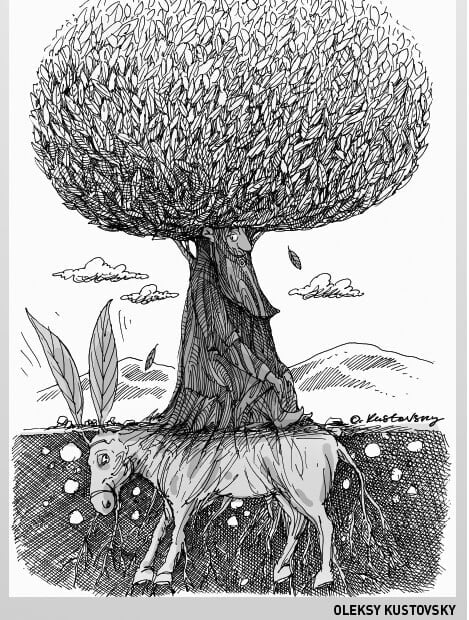
As Nasruddin’s fame grew and grew, he began advising Kings and governors.
One day, a man who was greedy for enlightenment travelled all the way from Baghdad to ask Nasruddin a question about the afterlife.
Art by Oleksy Kustovsky.
He said, “I have heard that you are a respected sage and I want to ask you, what happens in the next moment after this?”
Nasreddin told him to follow and led the man through the crowded streets. At last, they arrived at a graveyard. Once there, he said, “I suggest you ask someone here.”
Death Comes for Nasruddin
Now, as all men must die eventually, Nasruddin’s time came as well. One day, while chopping wood in the forest, he felt very cold. He thought to himself, “Ah, I must be dead.” and so Nasruddin lay in the forest and closed his eyes. After a while, he realized that no one would find him to take him to the cemetery, so he rushed home to his wife.
Upon seeing her, he called out, “I have died. Please tell the neighbours and friends to come get my body.”
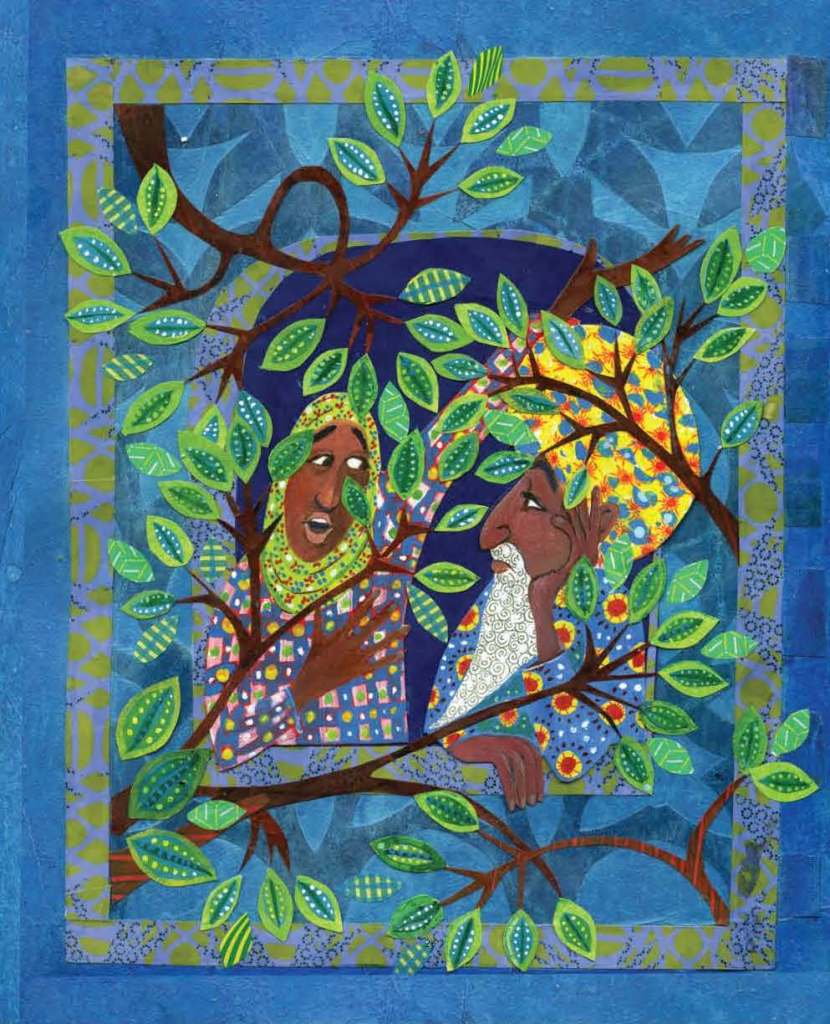
Nasruddin and his wife from “The Wise Fool” illustrated by Micha Archer
Nasruddin left quickly to go back to his final resting spot while his wife ran sobbing to the coffeehouse. Pounding her chest and crying, she shouted that her husband was dead in the woods. The men were astounded and asked how she knew if he had died in the woods.
“He came and told me,” she replied.
On his way back to the forest, Nasruddin hurried over to his lawyer about making a will.
Confused, the lawyer set to work and asked how Nasruddin would like to divide his estate. After a moment’s thought, Nasruddin said he would like to give a thousand gold coins to each member of his family, five thousand to an orphanage, five thousand to a mosque and twenty thousand to the poor of the city. The lawyer was amazed and asked how the mullah was so wealthy.
“Oh, I don’t actually have any money.” Nasruddin explain. “I just have great feelings of generosity.”
And with that, Nasruddin returned to lay dead in the forest.
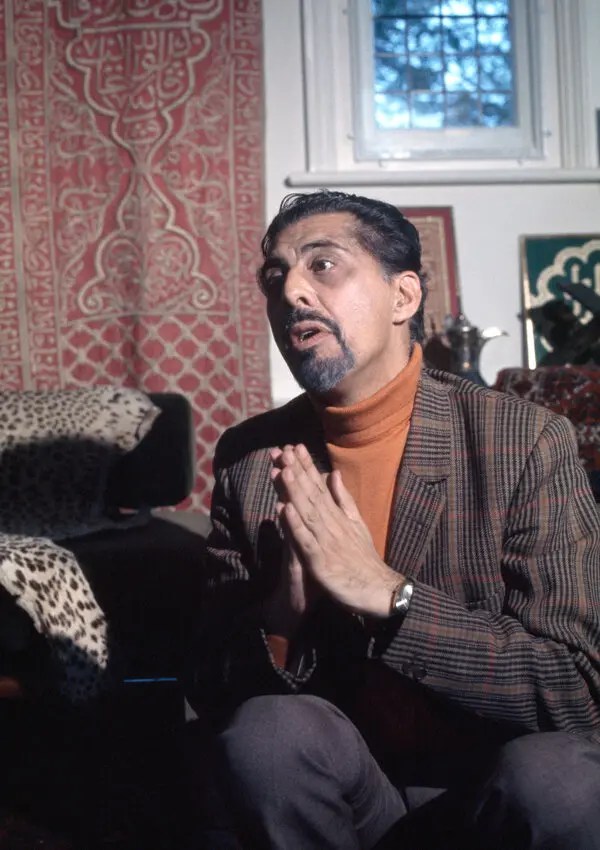
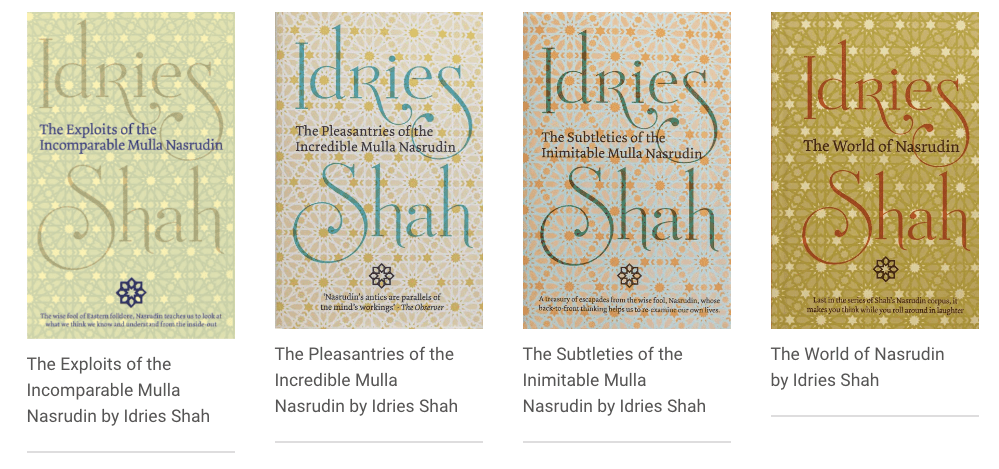
If you want to find your own Nasruddin stories then be sure to check out Idries Shah’s books!
Storyteller, translator, philosopher and a scholar in every sense of the word, Idries Shah’s works cover a wide range of Sufi works. His collection on Mullah Nasruddin can be read here.