
Fatima and the Crow
Iran, 11 minute read
Forough Hekmat collected these tales from his own childhood in Iran. Fatima may be a little old woman, but her heart is massive and her courage in the face of injustice. A story for all of us who ask, how far can kindness go?
Countries worldwide are ushering in the Spring Equinox with all kinds of festivals, but on March 20th, it was also the Persian New Year, Nowruz, so to honour that, we have a Persian folktale called “Fatima and the Crow.” This tale is from the “Folktales of Ancient Persia” as retold by Forough Hekmat, who recalls the stories of his childhood in Shiraz, Iran. His stories came from his parents, relatives, tutors, servants, nurses, and professional storytellers- all gathering together in the evening when there was nothing to do but sit on carpets next to rosebuds and share thrilling tales of heroism, adventures and love.
If you want to hear more Persian stories, check out:
- The Love Story of Shirin and Khosrow
- The Shahnameh Stories
- The Poor Prince: An Afghan Tale
- Persian Pumpkin Folklore
Fatima on a Dark and Stormy Night
Yeki Bood, Yeki Nabood. There was one, there was no one. There was once a little old woman named Fatima. She was smaller than a dwarf, but her generosity made her heart as large as any angel’s. Whenever anyone needed anything, they knew they could visit Fatima in her house, which was no bigger than a siev,e where she would sit under a fig tree the size of a broomstick beside a pool no larger than the bottom of a cup. When she finished her housework, the old woman would be content just to sit on her small mattress, smoke her pipe and smell her rosebuds.
Our story takes place one winter evening after Fatima had snuggled into bed to escape the chill of a violent storm that raged outside. When it was at its very worst, there was a knocking at her gate, and Fatima went to see who it was. Opening the door with one hand and struggling to straighten her veil with the other, Fatima froze when she spotted a drenched crow at her stoop. The miserable-looking creature asked for shelter and promised to be gone by the first prayer call of dawn.
Of course, Fatima let the crow in, and he happily perched on her fig tree until the rain clouds finally gave way to the brilliant dawn sky. When Fatima awoke, she found the crow merrily eating a fig.
In return for her hospitality, the crow gave the old woman a glossy black feather and told her to throw it into the air and follow it if she ever needed to find him.
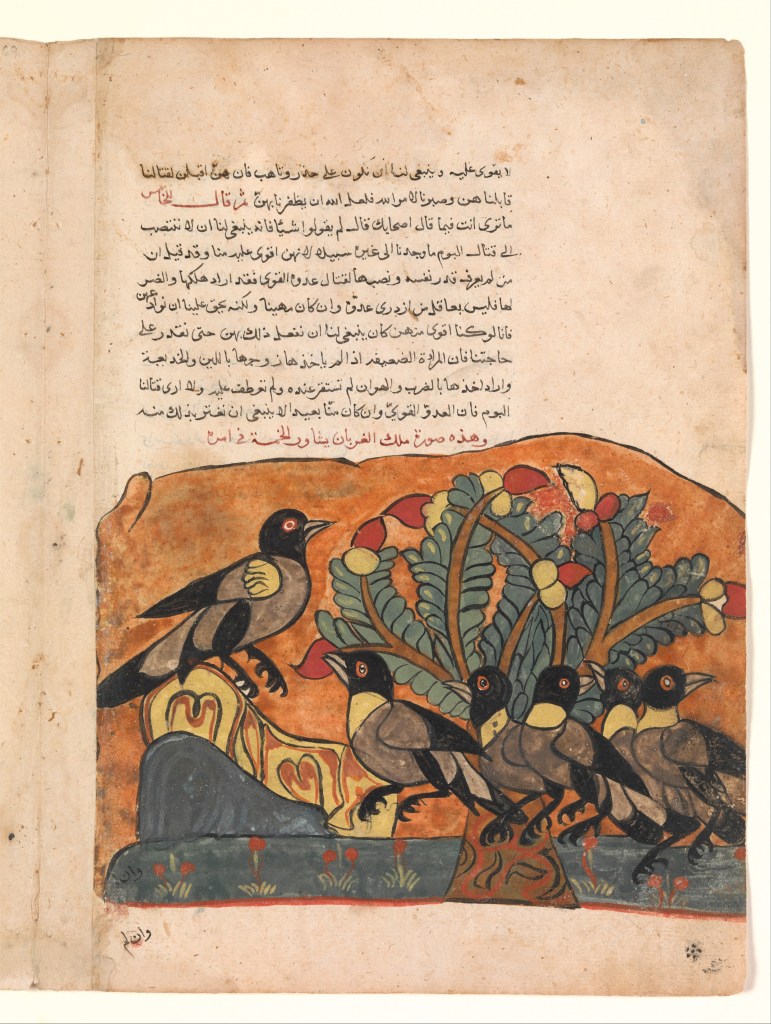
“The Crow King Consults his Ministers”, Folio from a Kalila wa Dimna. The Alice and Nasli Heeramaneck Collection, MET Museum.
Magic Item Saved for a Rainy Day
Time passed as it always does, and Fatima grew busy caring for her town. One day, stooped and tired, she wondered what else she could do to help. As she contemplated her frailty, she suddenly remembered the feather and went to find it.
Once she lifted the heavy lid of the box where she had stored the precious item, the feather flew up and darted out the door. With no time to think, Fatima chased after it. They travelled past fields of red tulips and large white ox-eye daisies. They moved past nightingales and sparrows that marveled in fear at the strange sight. They passed a rat in a cemetery who laughed and laughed as he shouted after her, “Oh, you do look funny, you little old woman, after that feather!”
Fatima was deeply offended by the red-eyed beast’s laughter, but not wanting to lose her feather, all she could do was bristle and call back for him to mind his own business.
Next, they came to a ruined palace where a young Dervish stared at her with bemusement and remarked, “How boring, there goes a little old lady chasing a feather.”
Once again, Fatima bristled in indignation and admonished him, saying it was rude to poke his nose where it did not belong. She knew what she was doing, and the scorn of others would not deter her from finding her crow.
The Deev and the Crow
After travelling far and wide, they finally stopped at the top of a mountain near a cave guarded by the largest Deev Fatima had ever seen. He had skin like a rhinoceros, teeth like a plow and two pointed horns protruding from his head. Fatima felt real fear for the first time since embarking on her journey. A Deev was no laughing matter. It could roast a man over a fire for a snack, and it could cause earthquakes with its laughter. Even the legendary hero Rostam struggled against one, and she was just one little old lady.
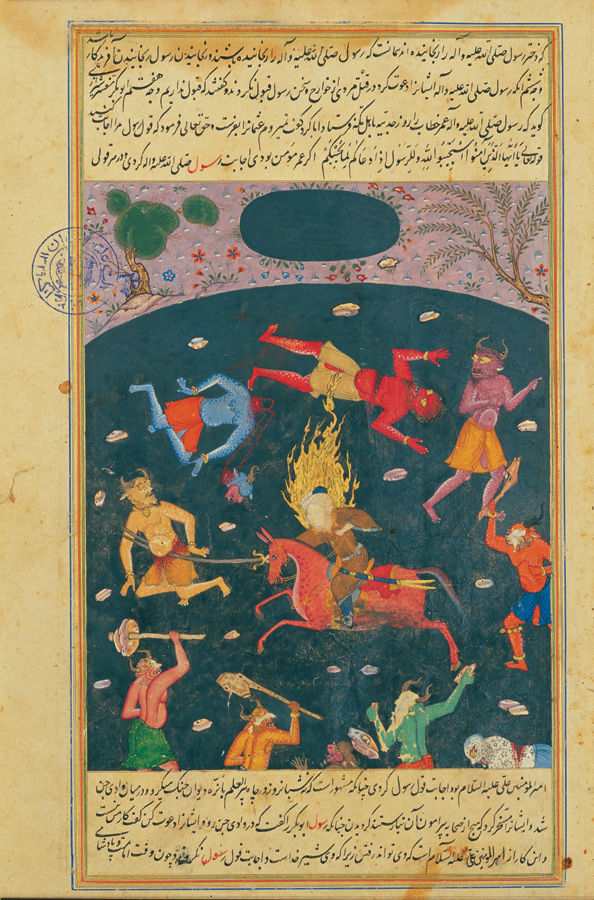
Rostam Conquers Div, unknown artist, book of Ahsan-ol-Kobar (1568)
Fatima knelt to the ground in a show of respect and said a simple greeting.
“Salaam,” she said. “Peace be with you.”
The Deev growled in response, but he seemed pacified by her polite greeting, so he asked what she was doing there and why she was trembling so much.
His voice shook her to her core, but the little woman bravely replied that she had travelled a long way and was cold. To her surprise, the Deev gently invited her in, and there, perched in the cave, was the crow. He was pleased to see her and asked what the matter was. When she explained that she had come simply to find a way to help more people, the crow affectionately named her the Little Grandmother, useful to all. With that, he gifted her a hen that laid golden eggs every morning. It would do so for as long as she lived, and she could do whatever she wished with it.
Fatima was delighted with this gift, and after bidding the Deev and the Crow goodbye, she followed the feather back home. When she returned from her journey, she tucked the feather away and made a nest for her hen.
The Golden Eggs and the Gold Digger
The hen lay golden eggs the next day and every day hereafter, but our story does not end here. You see, when a person comes about a great thing and uses it for a great cause, others will often marvel at their treasure. Some thought it was a miracle, and others thought it was a freak of nature.
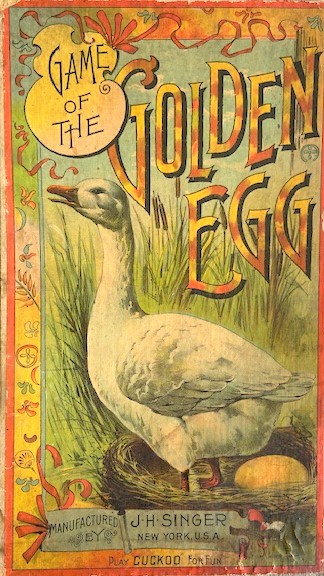
All About Fun and Games‘ Jenny Kile explores “The Game of the Golden Egg” by J H Singer.
People came from every quarter to see the little lady and her golden hen. Everyone except for the wise old men who shook their white heads thoughtfully because they knew that soon the chief citizen, the Kad-Khoda, would covet the creature.
This villain was wealthy, but like most, he was never satisfied with his lot and felt entitled to more. He had a great belly that shook as he walked and a long beard that swept the ground before him and flopped up and down whenever he opened his mouth. As the wise men had predicted, as soon as he heard of the hen, he decided that he deserved the golden eggs and not some old woman. So he had Fatima brought to him and after inquiring about her hen, asked if she would leave it with him for a night. Sweet Fatima, who helped all, innocently obliged him, but the next day she found that he had returned a normal yellow hen to her and not hers. Surely, she thought, this must be a mistake. How could the Kad-Khoda cheat people?
She found out soon enough when she went to confront him and was driven away from his presence. Crying, she released her feather and followed it to the Deev and the Crow. Both creatures listened to her troubled tale and the crow gifted her a copper pot and spoon. This would create whatever she wanted when she put it over a fire and made a wish.
If this magic item seems familiar, that’s because it is! We’ve covered another similar item in the Norwegian story of “Why the Sea is Salt” where the Devil gives a poor man a mill that can churn out anything he wishes.
The Second Gift
So, Fatima returned home and used her new gift to feed the hungry until there were no starved or thin faces. Even the animals and birds were full from her generosity. The Kad Khoda learnt of this and naturally assumed he deserved the copper pot as well. It made his mouth water just thinking of all the things he could eat.
The next morning, Fatima was surprised to see the fat man and his servant at her little door, but her gentle nature forbade her from turning them away, and so she accepted the man’s apology for the misunderstanding and let him in for lunch. The greedy villain asked for chicken kebabs, turkey, rice, fruit, yellow-rose halva and lemon sherbet. Fatima went into her kitchen and returned with the food. Of course, he once again asked to borrow her items, and she did not want to quarrel with him, so she obliged. Once again, the items returned to her the next day were just an ordinary pot and an ordinary spoon. And once more, she followed the feather tearfully to the crow’s cave.
She sobbed about the villainous, crafty man. It was not her nature to refuse anyone, but surely the man had gone too far this time.
The Third and Final Gift
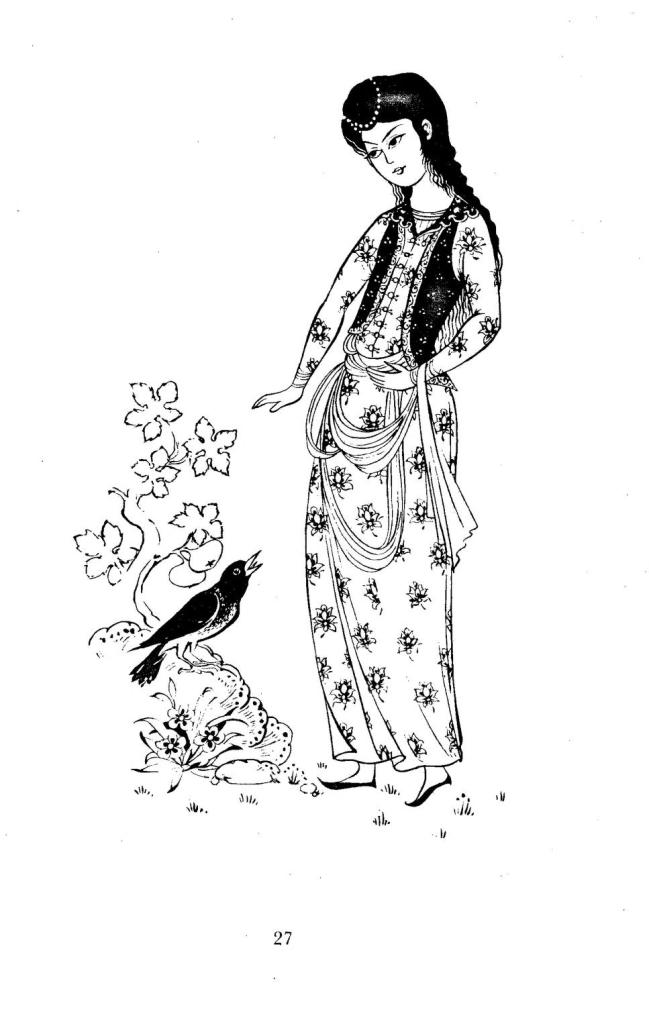
The crow comforted her by saying that there are those who will only do good if they are forced to. After some thought, he gave her a hollow golden pumpkin and told her it would teach the Kad-Khoda a lesson.
“Folktales of Ancient Persia” by Hekmat and illustrated by Muhammad Bahrami.
The crow comforted her by saying that there are those who will only do good if they are forced to. After some thought, he gave her a hollow golden pumpkin and told her it would teach the Kad-Khoda a lesson.
This time, Fatima marched straight to the fat man’s mansion and shouted at his gate that he had better let her in. The Kad-khoda was merely amused by the little woman’s daring and let her in. When she saw him, Fatima raged and called out for him to tell the truth and shame the devil. He had better return her items and take her advice, or he would regret it.
Naturally, this made the Kad-Khoda grow angry, and he advised her to leave before she regretted it. Fatima was undeterred and told him that she lived to help others and that he should do the same. If he did not answer for his greed in this life then he would answer for it in the next.
The Kad-khoda laughed so hard at her naivety that even those outside the mansion could hear the rumble. But what set Fatima off was when the greedy, bulbous man snorted that everything belonged to the strong.
Moment of Revenge
“That is not only wrong but insulting,” Fatima said. “I may be small, but I remember the words of the poet:
Since men all come from the same source
They are one body’s separate parts:
Hard fortune strikes no limb alone.
For all will sense his loss of peace.
The one who does not feel the misery
Another feels cannot be called a man.”
There was silence. The servants were affronted on their master’s behalf and turned to see him, red-faced and tongue-tied. Everyone was frightened except for Fatima, who finally realized there was no reasoning with him. So, she threateningly pulled out her pumpkin and chanted the words the crow had taught her, “Out, out, hundred mace-bearers, and defeat the oppressors!”
The mansion was suddenly full of mace-bearers that chased the Kad Khoda onto the streets. The people were thrilled to see their hated chief run around like a scared child, his belly swinging in front of him and his feet tripping over his beard. Finally, the Kad Khoda came crawling back to her, trembling and begging her to call off the warriors.
Fatima happily obliged, but only if he returned all that was hers and set the town right. The Kad Khada tried one last feeble protest but couldn’t form the words with his shaking lips, so he relented. From then on, everyone was full, busy and happy. As for Fatima, she was content to sit on her rug under her fig tree by the small pool in her small house and smoke her wooden pipe while smelling the roses.
“This is good enough for me,” she said.




 Tales from the Enchanted Forest
#/media/File:Imam_Ali_and_the_Jinn.jpg)