
Greenland, 8 minute read
What happens when a brother mocks his unmarried sisters? Well, they get carried off by animal bridegrooms and must be rescued!
Today’s story comes from the book, Eskimo Folktales, collected by Knud Rasmussen and translated by W. Wooster.
Knud Rasmussen was an anthropologist and polar explorer in the early 20th century. His native name was “Kunúnguaq” and he collected tales from all over Greenland with a deep understanding of the role of the Eskimo storyteller. Some stories, like that of “The Eagle and the Whale,” are full of similar tropes that sprouted from ancient storytelling traditions like that of the brothers rescuing their sister from the animal bridegroom.
Unmarried Sisters get Bridegrooms
No one has ever heard this story to the end. A long time ago, in a small idyllic village, there lived a big family with many brothers but only two sisters. These sisters were of marrying age, but neither showed any interest in getting married. Many had urged them to take a husband because heaven forbid we have a young single woman in these stories.
One day, one of the brothers approached his sisters and jokingly asked one of them, “What kind of husband would you want anyways? An eagle perhaps? Very well, you shall have an eagle.”
He turned to the other and said, “And how about you? Would you like a whale? Then a whale it shall be.”
Before either of these girls could argue or explain how absurd these statements were, a mighty Eagle swooped down and snatched the first sister. He flew high into the sky and brought his new bride to his nest on a ledge of a steep rocky cliff. Simultaneously, a fearsome Whale breached the beach and stole the other sister away to a rocky cavern.
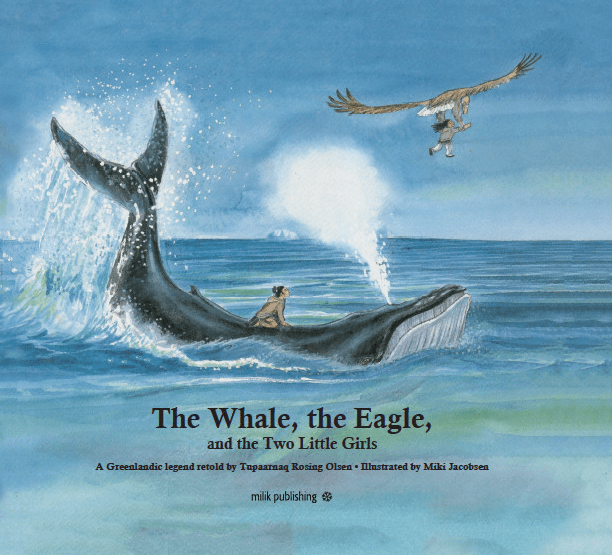
In some retellings, like the one by Tupaarnaq Rosing Olsen, the girls jokingly claim the bridegrooms themselves.
Afterwards, the sisters lived with their new animal bridegrooms. The one married to the Eagle spent her days on the high rock ledge near a cliff. To no one’s surprise, the sister was very displeased with this arrangement. So whenever the Eagle flew away to hunt prey in the sea, his bride worked on creating a rope to escape.
She would quickly hide the rope whenever she spotted her husband flying over. Some days he would return with a walrus in one claw and a narwhal in the other.
After some time, the brothers began to miss their sisters and felt remorseful for pushing them to get married. So, they started working on crossbows and soon, more villagers joined them. One such helper was a homeless boy who was so weak and malnourished from living on the streets that he could not even draw a bow.
Once their preparations were complete, they set out to rescue the sister. Instead of leaving the weak homeless boy behind so that he could get help and avoid this likely dangerous encounter, the brothers brought him along for the ride to the Eagle’s nest.
The Fall of the Eagle
From atop her straw tower, the sister spotted the convoy and caught her brother’s signal to bring herself down. How they knew that she was working on a rope and had a way to get down is beyond us (and probably them). She waited and once her husband left to hunt, she secured the rope she had made and safely made her way down, reuniting with her brothers.
Meanwhile, the Eagle caught two walruses. He left one at his wife’s brother’s house, and the other he brought home for his wife. While he did not notice that his wife was already hidden in the village, he did notice that his wife was not at his nest. With a knowing sigh, the Eagle tossed his catch aside and flew to the brother’s house. The Eagle dove at the house, but the brothers kept him at bay by shooting at him with their crossbows.
Unfortunately, the brothers were not expert archers. While the volley of arrows kept the Eagle at bay, none could hit him. Eventually, the little homeless boy cried out, “Let me try too!”
So one of the boys drew an arrow back for the little boy. The little boy aimed carefully and released. The arrow struck true, causing the Eagle to fall to the earth with a great thud. Thus, the little boy and the brothers killed the first sister’s husband even though he was a mighty warrior.
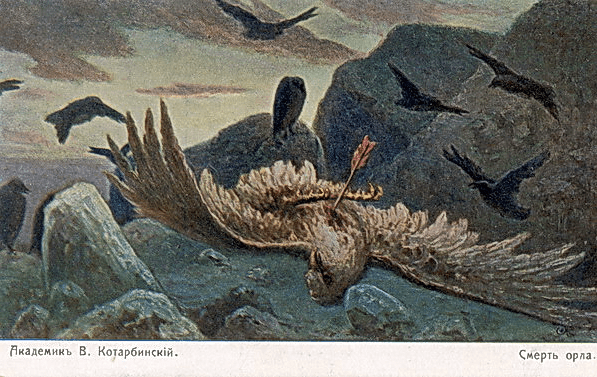
Death of an Eagle by Wilhelm Kotarbinski
All is Not Whale
Meanwhile, the second sister was living with her whale of a husband. Despite the very easy pun here, she was not having a whale of a time. The Whale loved his wife very much, but unfortunately, he went to the school of possessive boyfriends and would never let her out of sight.
The second sister did not love her current situation and started plaiting a line of sinew threads to make a rope for her escape. Unbeknownst to her, the brothers had begun making a swift-sailing umiak to rescue her.
Once the boat was made, they all gathered in and set off. As they got closer, they found a guillemot (a small black and white seabird) in its nest. They asked the bird if it could fly beside them and see if their boat was quick enough to overtake a whale.
The guillemot agreed, but soon enough the bird flew past them. The bird told the brothers that to overtake a whale, they would need to take the boat apart and build a new one.
The brothers heeded this advice. They took the boat apart and built a new one to test against the bird. They were neck and neck for most of the race, but the new ship pulled ahead when they neared land.
Days later, the girl told the Whale that she had to go outside for a little while alone. Her husband objected and ordered her to stay, but she insisted. This was an almost daily exchange between the two of them. However, she had finally finished creating the length of rope and was determined to use it today. If she stayed one more day with her Whale husband, then she would blow her top!
She tied the string around her ankle to prove she would go no further than outside the passage and handed the other end to her husband. She explained that she would not be able to go farther than the length of the string, and he could always pull her back. Reluctantly the Whale agreed, but once she was outside, she retied the string to a stone and ran away as fast as she could. Her brother’s house was not far down the hill from where she was, so she made a beeline for them.
After a quick reunion, they all got into the umiak and sailed off to get as far away as possible.
Cutting back to the Whale, it didn’t take long for him to realize that he had been tricked. As the brothers and sisters boarded the boat, they saw the Whale bust out of the cave and roll out into the sea. They moved quickly, but it felt like they were standing still compared to the swift Whale.
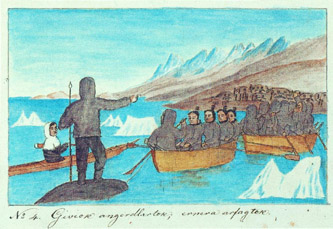
Aron of Kangeq’s illustration. 1860.
When the Whale was nearly upon them, the brothers told the sister to throw out her hair band. Without questioning the bizarre request, she tossed it and the seas began to foam up. This temporarily slowed the Whale down, but he soon gained on them. Now the brothers told her to throw her mitten. As soon as it hit the water, the sea foamed again and slowed the Whale down. This process repeated with her inner mitten, outer and inner coat. At this point, they could see land and needed one more item as a final push.
Finally, she threw her bracelets into the sea, and the Whale raged as he fell behind. The brothers and sisters arrived safely on shore. The Whale tried to follow but was cast upon the shore as nothing more than a white sun-bleached whalebone.
So that is the story of the Eagle and the Whale. This is just one of those stories that made me laugh and cringe. The brothers caused the initial issue- presumably on a whim. Then they missed their sisters so they straight up murder their husbands to get them back. It’s just a lot of extremes going on and these sisters have hardly any say in the matter. At least by the end when they work to rescue themselves, their brothers return to help them (which is saying a lot for brothers in fairy tales).




 Tales from the Enchanted Forest