
Welcome back Travellers to another tale that will remind you just how fun some fairy tales can be and fall in line with the current trend of myth retellings. The Romanian tale of “The Flower Queen’s Daughter” is definitely a version of the seasonal Persephone story, however, this one includes lots of mysterious old people, flirty Dragon mothers, runaway mares and a Flower Queen (plus her daughter).
Stick around till the end for our Five Fantastic Finds on:
- The World’s Most Beautiful Woman Trope
- Maternal Monsters
- Dances and Balls
- Persephone’s Dragonborn
- Sunk Cost Fallacy
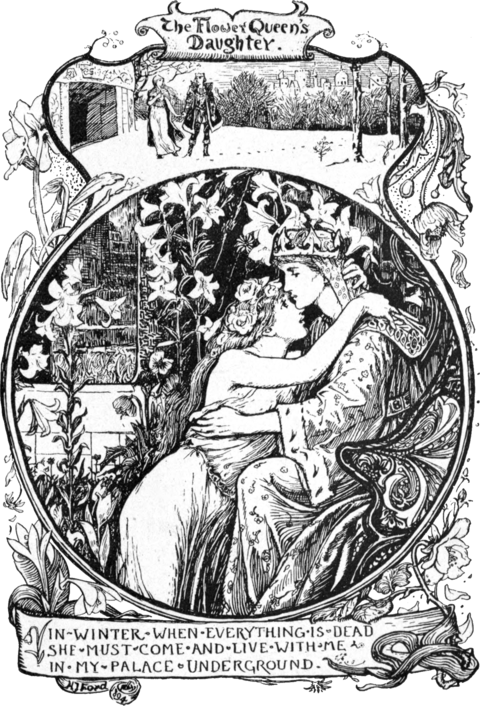

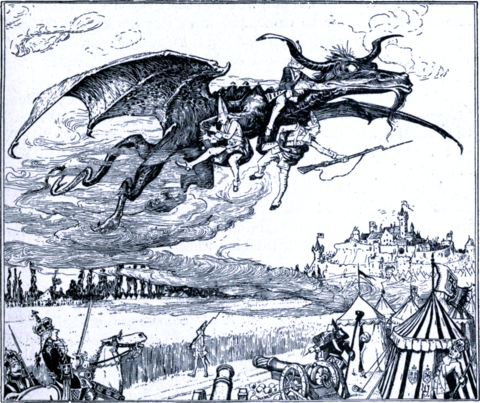
Images from Andrew Lang’s Yellow Fairy Book with illustrations by H.J. Ford.
The Flower Queen’s Daughter
A young Prince was out for a leisurely ride when he almost rode into a deep, open ditch. He reigned his horse to a sudden stop when he heard a cry from below. To his astonishment, an old woman was trapped beneath, and being the good sort of Prince, he set out to rescue her. Turns out, it was as simple as hoisting her up.
When she was safely on solid ground, the Prince asked her how she fell into an obvious ditch. She replied that she had set off at midnight to sell her eggs in a nearby town but had lost her way and fallen into the ditch. Seeing as she was old and probably injured, the Prince helped her onto his horse and took her home.
Like most of us, the old woman hadn’t met many kind Princes, so when they arrived at her house, she went inside to get something special for him. Upon her return, she looked at the Prince carefully and exclaimed, “You are a mighty Prince with a kind heart. Wouldn’t you like to have the most beautiful woman in the world for your wife?”
The Prince laughed and agreed that he would, secretly hoping the old woman wasn’t talking about herself. To his surprise, the old woman began relaying an odd story. She told him that the most beautiful woman in the world was the daughter of the Queen of the Flowers and had been captured by dragons. To marry her, he had to set her free first. Then, the old woman produced a tiny bell from her pocket.

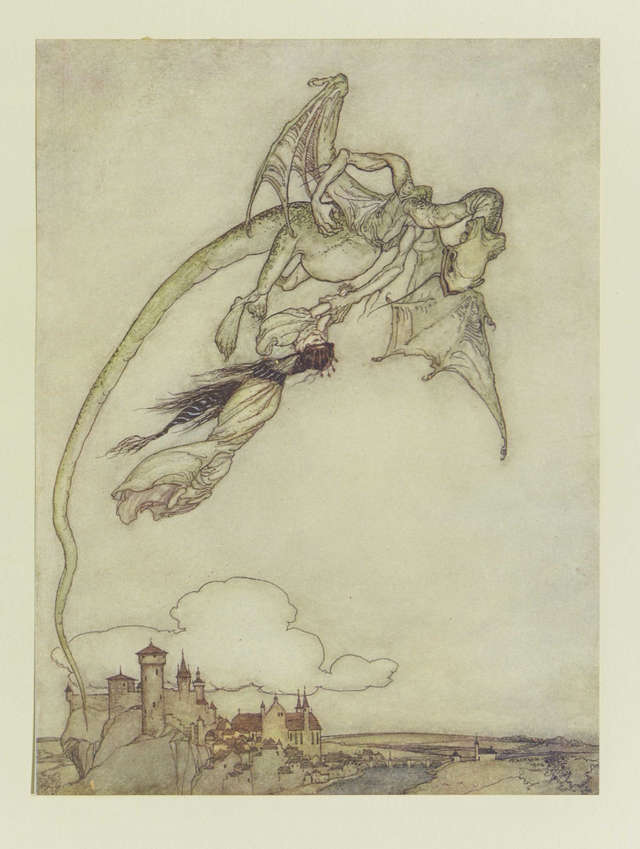
Various illustrations by Arthur Rackham
“If you ring this once, the King of the Eagles will appear; if you ring it twice; the King of the Foxes will come to see you and if you ring it three times, then the King of the Fishes will be at your side! These will surely help you on your journey.”
The Old Woman, whom the prince was beginning to suspect was more than just a regular, hapless old woman, bid him luck and headed inside her house. When the Prince went to follow, the ground began to shake. The Earth literally opened up and swallowed her house whole.
More Old People
As Princes in fairy tales tend to do, this Prince threw himself wholeheartedly into this mission for a woman he had never met. He travelled the world for a year and, at some point, even his horse had died of exhaustion. Instead of taking that as a cue to go home and settle for the second most beautiful woman in the world, he miserably continued his quest. Surely, he would be there soon enough.
Finally, he came upon a hut where an old man was said to know the whereabouts of the Dragons. However, that old man replied that no…he did not know where the Dragons had carried off the daughter of the Flower Queen, but he advised the Prince to travel straight along the road for a year to where the man’s father lived. Perhaps he could tell the Prince about the Dragons.
So our weary Prince followed the road for another year until he reached a very old man. This man also had no idea what the Prince was talking about but, he guessed that if anyone would, it was his father! Who- you guessed it- lived a year away down the very same road. At this point, the Prince had been traveling for over three years so it would have been a sunk cost fallacy to stop now. He thanked the very old man and headed down the road for another year until he came upon the very very old man.
Unsure if the man was alive, the Prince cautiously approached the ancient-looking figure on the porch. Feeling a bit foolish, he spoke out loud and declared that the man’s son and grandson had sent him. After what felt like forever (during which the Prince questioned all his life choices) the very very old man spoke.
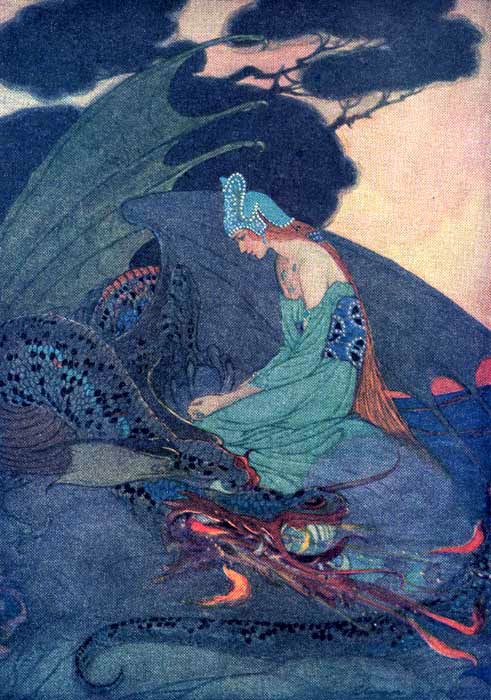
“The Dragon you seek lives up there on the mountain and he has just begun his year of sleep. If you wish to see his prisoner, the Flower Maiden’s Daughter, then you must go to the second mountain where the Dragon’s mother holds a ball every night.”
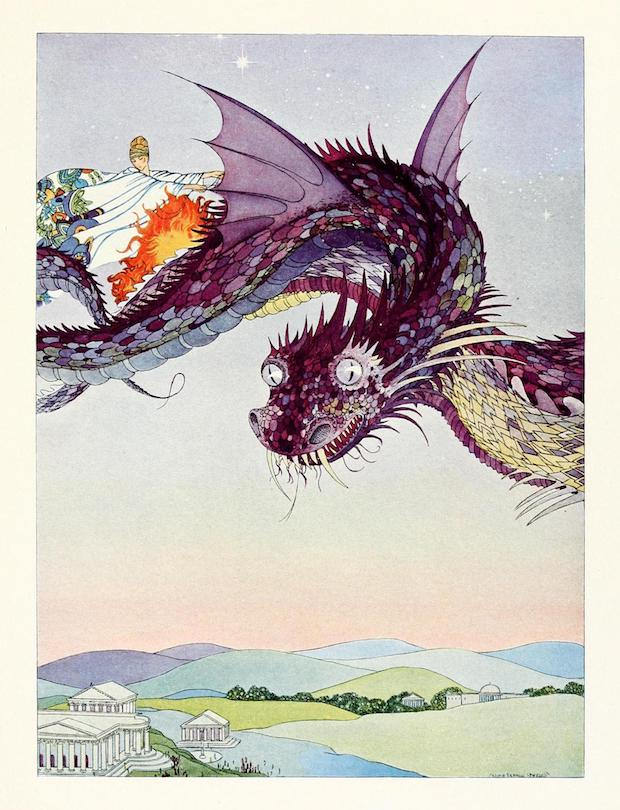
Illustration by Elenore Abbott
The Prince tried asking more questions but it seemed like the man was done answering, so the Prince thanked him and went on his way to climb the second mountain. Hopefully, it would not take him a year to climb and he secretly hoped he would not meet any more evasive old people along the way.
House of the Dragon
When the Prince reached the top of the second mountain, he was startled to see a castle made of gold with glittering diamond windows. He was not sure what he had been expecting. Maybe a cave with hoarded treasures or even a grisly tower.
The Prince contemplated what to do but was quite tired, so he decided to face the problem head-on by walking through the gate. That is how our Prince found himself immediately surrounded by seven furious dragons, all towering over him and demanding to know what he wanted.
Thinking quickly and hoping there was no “Dragon Father”, the Prince replied that he was there to see the Great Dragon’s mother. He had travelled far and wide after hearing of her legendary beauty and kindness.
The Dragon Guards were hesitant but flattered on their Queen’s behalf. So, they led him down twelve splendid halls to the Mother Dragon. After seeing the splendour of the palace, the Prince hoped the Queen would be just as lovely. To his disbelief, she was the ugliest woman under the sun with three grotesque heads. When she opened her mouth to ask him why he had come, her voice was like the croaking of ravens. The Prince masked his disgusted shock for astonishment and begged the Queen to enter her service. He said he would do anything to be near her.
The Three Day Task
The haughty Queen was flattered and fanned her three heads as she pondered his request. He was a very handsome Prince after all. She eventually agreed but she wanted the measure of the man first. As a test, he would have to lead her mare out every morning and bring her back every night for three days. If he failed then they would eat him up. It was a win-win for the Queen.
Secretly wondering why a dragon would need a horse, the Prince agreed and left to bring the skittish mare out to the meadow. However, as soon as they reached the grass, the horse vanished. The Prince was- quite frankly- over this. However, he did not spend three years and the death of his own beloved horse just to fail now.
The Mighty King of the Eagles
As he cursed the old woman in the ditch, he suddenly remembered the little bell she had given him. After all these years, it had remained in his pack. Taking it out, he rang it once.
There was a rushing noise next to him and a mighty Eagle landed. The feathers along its head gleamed like a crown and the Eagle spoke before the Prince could ask for his help.
“I know what you want from me. The Dragon’s mare is galloping freely in the clouds. I will gather my kind and steer her back to you.”
The Prince didn’t even have time to say thank you or ask a question like “did the Eagles consider themselves a deus ex machina mechanism by saving Gandalf and later Frodo and Sam?”

Before he knew it, a flock of what looked like thousands of eagles were flying toward him and at their helm was the startled mare. He grabbed hold of her and reigned her in as the eagles flew away. He would never have his Middle Earth questions answered but at least he wouldn’t be eaten by the Dragon tonight.
Illustration by Edmund Dulac
Till the Clock Struck Midnight
When he returned the Mare, the Dragon Queen was delighted and gave him a cloak made of copper to wear to her ball that night.
There, amongst the dragons, was the loveliest maiden the Prince had ever seen. She wore a dress made of flowers and her face was like that of lilies and roses. The Prince risked dancing with her and whispered, between twirls and dips, that he would rescue her. The Princess replied that if he lived till the third day, he should ask the Dragon for a foal of the mare.
They danced until midnight when the Flower Maiden was whisked back to her room.
The Sleek King of the Foxes
With more gusto now that he had seen the fabled Flower Maiden and could confirm this was all worth it, the Prince took the mare out the next day. Again, she disappeared and the Prince rang the bell two times. This time a sleek King of the Foxes came bounding next to the Prince. This time all the foxes in the world came together to find the mare and return her to the mountainside.
Ironically, in setting the Flower Maiden free, the Prince was actively helping keep this mare prisoner. With the help of other animals. Twisted.
This time, the Dragon Mother gave him a cloak made of silver and danced with him at the ball. When he found a moment to sneak away, the Prince danced with the Flower Maiden and she whispered for him to wait for her in the field with the foal after the next ball.
The Silky King of the Fishes
The next day, the Prince took the escape artist mare to the field. This time when it escaped, he rang the bell three times and the King of the Fishes appeared in the nearby river. The King said they would return the Mare who had hidden herself in the rivers.
That night the Dragon Mother was overjoyed to see the Prince alive. She had grown fond of the idea that he came all this way and worked hard to please her. In fact, the Dragon Mother had grown quite lonely in her palace and was looking for someone to help water her gardens. She gave him a golden cloak to wear to the ball but asked him what else he wanted. He could have anything he desired.
The Prince thanked the Queen and begged for the Mare’s foal. The Queen obliged his simple request and they went to the ball together.
With the Queen’s attention on him, the Prince only managed to slip away close to midnight. He had not risked looking for the Flower Maiden, so he had no idea what her plan was when he mounted the foal and rode him to the mountainside field.
The Great Escape

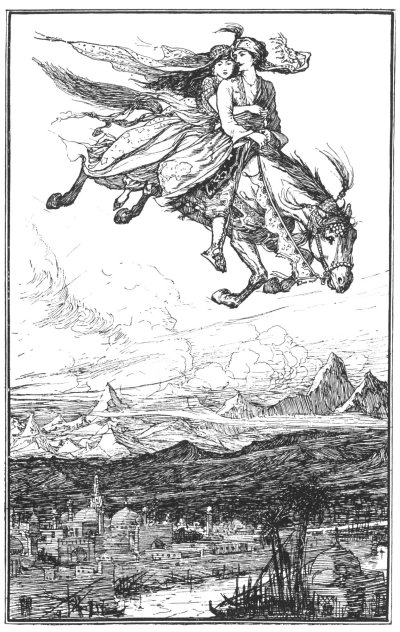
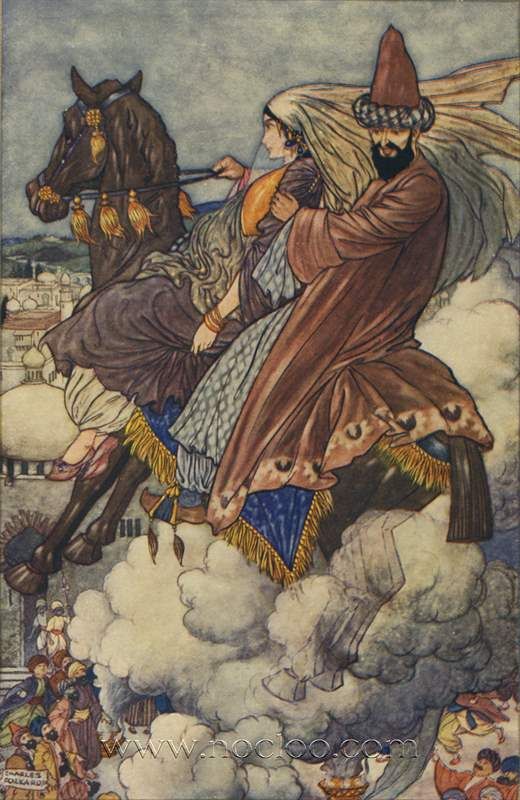
Illustrations by Arthur Rackham, H.J Ford and Charles Folkard
Towards midnight, the maiden rushed out of the palace and the two rode like the wind towards the Flower Queen’s dwelling.
When the Dragon Mother went to retire with her new lover, she noticed he had gone missing and became furious at his deception. The Dragon woke her son and he raged at the loss of the Flower Maiden and the skeevy Prince that duped his mother. He left to chase them, planning on laying siege to the Flower Queen’s dwelling.
But, the Prince and Maiden had a headstart and reached the Flower Queen’s underground palace just in time. The lands above it had grown so barren that the Maiden almost did not recognize her home at first, but when she saw her mother, she knew everything would be alright. The Flower Queen was overjoyed and her tears flowed, creating a forest of flowers as high as the sky to cover the palace.
The Dragon flew circles around the thorny brambles, but with no way in, and no way to find the underground entrance, he soon relented and flew back home.
A Seasonal Agreement
The Flower Queen was pleased to have her daughter back and was none too happy about the prospect of her daughter leaving so soon. However, she consented to their marriage as long as her daughter was returned to her every winter when everything above ground was dead.
The young couple accepted these terms and finally, after nearly three years, the Prince returned home with his beautiful bride. They lived happily until winter came and the Maiden left to live in her mother’s underground palace. Despite this constant coming and going, the two lived happily ever after.
The End.

Trope: The Most Beautiful Woman
One of the big staples in fairy tales is that the main female character must be beautiful. Sometimes, this is taken one step further and she has to be the most beautiful girl in the entire world.
The tale of the Flower Maiden’s daughter falls into the latter category. It’s never clear if the old lady just decided this, if she heard it from someone else, or if there was a beauty contest held to determine this. Now, there are often a lot of nitpicks on what truly makes someone beautiful- or shall we say, what makes someone the fairest?
This trope is explored twice in one of the oldest epic tales- the story of the Trojan War. It all started with a dispute over which Goddess would get the golden apple labelled as “for the fairest.” The other Gods entrusted this decision to a shepherd-but-also-a-secret-Trojan-Prince named Paris and naturally, each of them bribed him for the title. Hera offered him the power to be king of the world, Athena offered him wisdom and glory in battle, and finally, Aphrodite offered him the most beautiful woman in the world, Helen. Paris chose Aphrodite’s offer and Paris made off with Helen of Sparta. The only problem was that she was married already to Menelaus and years ago, all her suitors made a pact to go after anyone that stole her away. So, not only did Troy have to deal with the Greeks, but also the wrath of Hera and Athena. All for the fairest woman in the world.
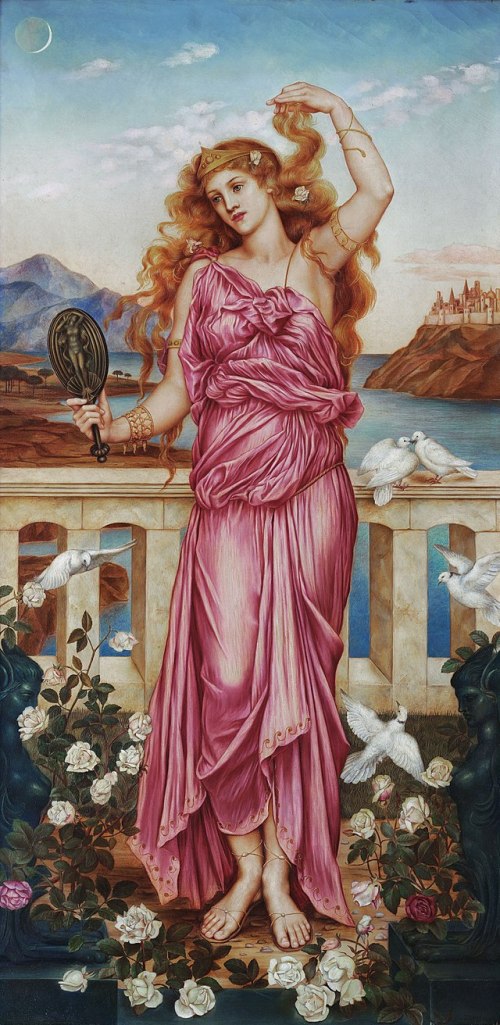
This is also not our first time covering a story with this trope. Princess Kaguya from the Japanese “Tale of the Bamboo Cutter,” is also described as the most beautiful woman in the world. She was actually from the moon which did explain her more out-of-this-world beauty. Also, Kaguya and the Flower Queen’s daughter are both related to semi-divine beings, but this kind of connection is not mandatory for someone to qualify for this title. We also have this trope play an important role in the stories of Princess Aubergine and Siya and Maadi.
Maternal Monsters
Finding a living or kind mother in a fairy tale is rare. We’ve covered this trope before when discussing stories like Donkeyskin or Beauty and Pockface. Stepmothers are depicted as evil to deal with the deep anxieties we have over portraying direct maternal figures as anything but ‘pure.’ But what about the mother of the monsters? Of course, we have Grendel’s mother from Beowulf, but what about in fairy tales? Who begets the monsters that our Princes fight?
There are various “Mother of Monsters” throughout mythology and religion. In some texts, Lilith is considered the first wife of Adam and after leaving him, she becomes the mother of monstrous creatures. There is also the Mesopotamian Tiamat who can either be seen as a creator Goddess or one of primordial chaos, just like the Grecian Gaia. If we are turning to Greek mythology, we can look at Echidna for Cerberus, the Lernaean Hydra, the Chimera, Sphinx and even the Nemean lion. Also, in Norse Myths we have the giantess, Angrboða, who has Hel, Fenrir and Jörmungandr with Loki.
These Mother of Monsters have inspired many works today with the most famous being H.P Lovecraft’s Shub-Niggurath and Grendel’s Mother from Beowulf.

Dances and Balls
Big fancy balls are a common occurrence in fairy tales and fantasy stories. They are big events where nobles socialize in dazzling ball gowns and dance the night away. And many romantic leads meet at such events only to seek each other soon after. Balls are also a great way for characters to enter new social spheres since there are a lot of comings and goings at these events. Sometimes invitations are required to gain entry but in fairy tales, characters often just need to be beautiful and dress for the occasion. In our story, the dragon mother had a ball every night. Which would not only be exhausting to prepare and attend but also hints at an indulgent lifestyle. To hear more about indulgent bars, check out our episode on the Twelve Dancing Princesses.
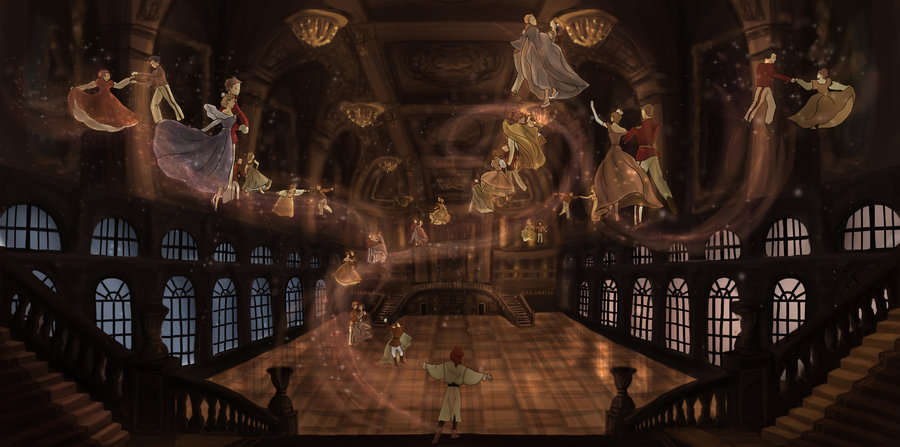
But big events like a ball can also be used for more sinister intentions. In the opening scenes of the movie Anastasia, the villain Rasputin, stages a revolt against the Russian royal family and vows to destroy them. Choosing to do this during a ball ensured that the entire royal family and their supporters would be in the one place at that moment. Of course, our protagonist, Anastasia, manages to escape but she relives the memories of that ball at a later point in the film.
Persephone’s Dragonborn
Listening to this story, you may recall the cycle of seasons as used in the Persephone myth from Greek mythology. We actually covered that story in our “Hymn to Persephone episode,” so be sure to check that out as well! However, did you know Persephone was also linked to a dragon story? It isn’t a very family-friendly story but it is important nonetheless. Basically, in most traditions, Persephone is the daughter of Demeter and Zeus and she captures the eye of literally every Olympian- including her own father. When Demeter sees everyone’s impure attention on her daughter, she turns to Astraios (Astraeus) the god of prophecy who warns her of a robber bridegroom and someone who will besmirch Persephone before marriage. Demeter is quite determined to prevent these two fates and so she uses a dragon carriage to carry Persephone into a grotto and hide her in a cave with the two dragons standing guard. However, Zeus finds the location of Persephone’s hiding place and disguises himself as a serpent to get in.
From that union came Zagreus-Dionysos and Zeus took the child to Mount Ida. Of course, Hera would not let this stand and spurred the jealous Titans to trick the young boy away with toys and dismember him. Zeus took Zagreus’ heart and made it into a potion for his lover, Semele. She went on to give birth to the second Dionysos.
In the Dionysiaca of Nonnus, Hera later manipulates Persephone into sending an Erinys to plague Duonysos with madness by telling her that Zeus saved his other children but could not save hers. He also gave Seleme a place in the heavens, but sent Persephone down to the gloom of the underworld! I’ll quote this bit because I think it’s said best in Nonnus’ own words: “What good was it that he put on the deceiving shape of a serpent, and ravished the girdle of your inviolate maidenhood, if after bed he was to destroy your babe?’”

In the video game series, Hades, Zagreus is the main character and the story follows his journey to escape his father’s domain of the Underworld. In some iterations of the myth, Zagreus is depicted as an underworld God, even going so far as to be synonymous with Hades himself.
Sunk-Cost Fallacy
A while ago, I was playing a new video game. After about ten hours of gameplay, I realized I wasn’t enjoying it. But I had purchased the game and put so much time into it, that I felt like I had come so far that I should just finish it.
Similar to the prince travelling for three years on nothing but a rumour, I found myself in a sunk-cost fallacy. We both had put so much effort into something even though it had shown no signs of a positive return. And because we put so much into these endeavors, we felt compelled to invest further until we felt it had “paid off”. Thankfully for the prince, this would ultimately show dividends, while I just lost too many hours to a disappointing game.
This happens because humans are not as rational as we would like to believe. Instead of focusing on the present situation and future costs to determine what decisions will bring the best outcome, we focus on previous investment’s irrecoverable costs to dictate a decision. Even if that decision is not in our best interests. It’s hard to realize that the time and resources previously poured into an endeavor cannot be recovered. As a result, we focus on our previous ‘loss’ instead of focusing on future gains.
The term for this cognitive bias was first coined in 1972 by Psychologists Amos Tversky and Daniel Kahneman. Over the years, more people have studied this phenomenon and tried to pinpoint why we are so susceptible to it. While the sunk cost fallacy is largely looked at through an economic lens, it also applies to our daily lives and relationships. It’s easy to get trapped in this way of thinking but it is important to recognize when it’s time to stop trying to prevent a past loss and start looking for a future gain.