

Welcome back to another Hans Christian Andersen story! This time we are covering a seemingly simple tale of “The Princess on the Pea,” or as it is better known “The Princess and the Pea.”
This story is one that really shows you the prowess of Andersen’s storytelling ability while simultaneously criticizing it. To many, this story is a moral-less, nonsensical failure of a wonder tale. To others, it is a treasure trove of snide commentary. Basically, it’s the type of story that makes eager English majors hungry for more.
At its core, the Princess and the Pea is a bride test or suitor test. However, unlike the tests in stories like the “Twelve Dancing Princesses,” or “East of the Sun, West of the Moon,” this one hinges on nothing more than a princess’ sensitive nature and thin-skinned, almost snobby behaviour.
Stick around for our Five Fantastic Finds on:
- An Immortal Tale: Andersen’s Critics
- A Hypersensitive Person
- Charles Boner: Translation Liberties
- A Variant of Pea Stories
- Tropes Galore


The Picky Prince
Once upon a time, there was a Prince who wanted to find a suitable Princess to make his Queen. Unfortunately for him and everyone who knew him, this Prince was picky about what constitutes as a real Princesses.
Whether the Prince’s preconceived notions of what a Princess was came from noble snobbery, a witches curse, or a self-imposed suitor challenge, the fact remained that the Prince was determined to find a suitable princess. So, he travelled around the world and met Princesses from all over. However, he always found a fault with them and refused each and every one. After another disappointing trip, he finally gave up and returned home.
Imposter Princess
One dark and stormy night, there was knocking at the city gates. For plot reasons, the old king went out to open it. Standing at the door was a girl drenched from head to toe. She claimed to be a stranded Princess, but the Queen-mother rolled her eyes at the claim. The girl looked more like a drowned rat than nobility.

The old Queen went to the guest bed chamber, removed the bedding and placed a single uncooked pea on the bed. Then she ordered the guards to put twenty mattresses on top of the pea and then twenty featherbeds of eiderdown on top of the mattresses. Afterwards, she led the Princess to this bed chamber and left her there for the night.
As a sidebar: Many critics point to this stormy scene as an indicator that the Princess is not as helpless as she seems but brave and resourceful for weathering the storm and making her way to the palace. Of course, in other variations of this tale, the Princess learns about the pea test prior to seeking out the Prince and purposely tricks him.
Artwork by Kay Nielsen
Two Star Service
The following morning, the old Queen slyly asked the Princess how she slept.
“Oh horribly!” Exclaimed the Princess, “I could hardly sleep a wink. There was something quite hard in that bed and my whole body feels like it is covered in bruises. It was horrible!”.
The old King and Queen looked at each other in shock. They knew she must be a real Princess because only one with a sensitive disposition could feel a pea through the mattresses and featherbeds. So, they declared her worthy of their son and the two were married at once.
The pea was displayed in an art gallery for all to see- unless, of course, someone has taken it since.

An Immortal Tale
The Princess on the Pea is one of those whimsical stories that almost everyone knows about, but no one can tell you what the moral of the story is. After all, according to scholars like J.R.R Tolkien, aren’t fairy stories and myths supposed to carry some moral or religious truth for their listeners to realize?
Critics cited this lack of morals when they tore apart this tale, which Andersen wrote for children as he would deliver to children. Some critics even argued that Andersen should let off writing wonder stories altogether, given that he failed to apply adequate morals to the tales.
So, what did Andersen think of all of this? Before publication, he wrote letters about the four-story collection and claimed it would be his ticket to immortality- however, he astutely wrote that it would not be an experience he would feel in this life.
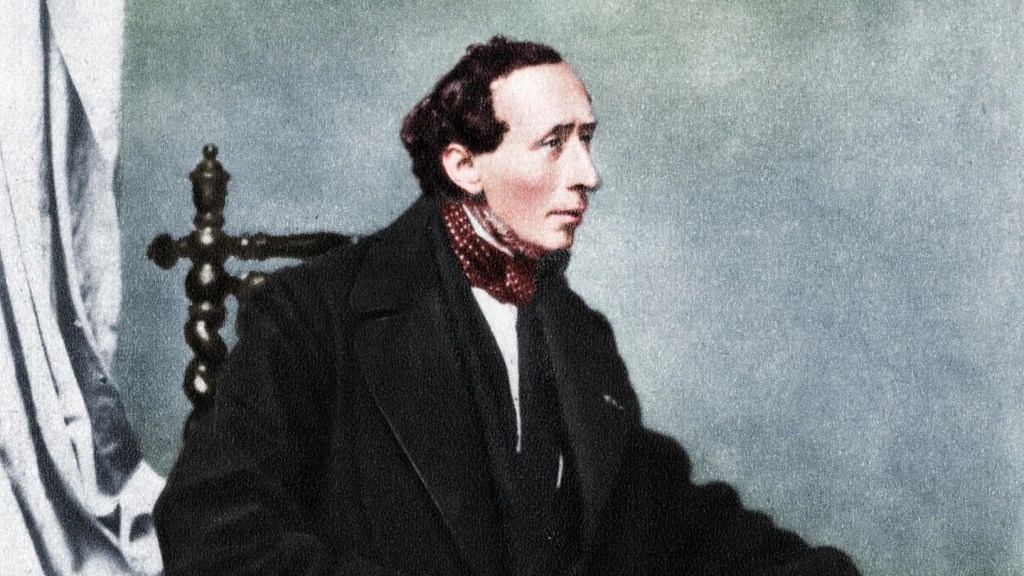
At first glance, The Princess on the Pea does not seem like a very deep or meaningful story, but it is an immortal tale due to the hyperbole of the mattress stack. On deeper consideration, the story is a tongue-in-cheek play on the nobility, and some critics argue it mocks the social expectations for nobles to be sensitive and pure. The lengths that the Prince and Queen go to with nonsensical tests to ensure the Princess is truly a ‘real’ princess shows the lengths the nobles will go to to secure their bloodlines.
However, other critics argue that the story alludes to Andersen’s personal relationship with the nobility. He was seen as something of a social climber and rejected by the Danish nobility. However, Andersen believed there was something inherent in his character that proved nobility beyond blood status. His sensitivity.
On another note, Maria Tatar wrote that unlike the folk heroines that Andersen drew his story from, the Princess in his tale does not lie or use trickery to achieve her means- she simply is sensitive to the pea and expresses it. It is up to the reader to decide if she truly was a princess or if her sensitivity simply made her one.


Photographs taken by Georg E. Hansen (middle – 1875) and Henrik C. G. Tilemann (1865).
I’m a Sensitive Guy!
Psychology defines individuals who are more sensitive than others as Hypersensitive Persons (HSPs). This personality trait was popularized in 1996 by clinical psychologist Elaine N. Aron in her book, “The Highly Sensitive Person: How to Thrive When the World Overwhelms You.” In the book, Aron shares her research findings and what she learned about how this trait affects others.
To summarize, HSPs tend to be more in tune with their emotions and can be seen as overly emotional. They are also more sensitive to external stimuli like light, sounds, or even colour. While the Prince was occupied looking for a ‘true’ Princess, he would have had better luck looking for a hypersensitive person! Aron’s research suggests that 15-20% of the population is highly sensitive.
So, what makes someone highly sensitive? Aron’s research indicates that this is an innate trait found in over 100 other species. But of course, there are cases of people learning or adapting to be more sensitive as well due to external/internal stimuli or experiences.
I Got a Bone to Pick with Charles Boner
Andersen wrote and released his Danish story in 1835, citing it as a childhood story he had heard. However, Andersen’s story and the English translation version had many inconsistencies that can be attributed to the translator with the unfortunate name, Charles Boner. Instead of working off of Andersen’s story, Boner translated the story from German. Although it is possible that the version Boner was working off of had these changes already, the blame for them has infamously fallen on Charles.
The first change was turning one pea into three, either to align with the common fairy tale rule of threes or simply because Boner thought one pea was not enough- it is unclear why this change was made besides to give credibility to the story as a ‘wonder tale.’
The most damning change, however, was the ending. In Andersen’s tale, the pea ends up in the museum and the storyteller’s voice joins in to add that the tale was true. Blurring the line between the fiction and fantasy elements supports scholar’s views that this tale was one of mockery.
In Boner’s tale, the story ends with a rhetorical question “Now was not that a lady of exquisite feeling?” His ending makes for a literal reading of the story and removes the added metaphor of the ending where the Princess, who may or may not be a real princess, is put in royal standing just as the pea, a common food item of peasants, ends up in a museum.
It is remarkably, unremarkable.
A Variance of Peas
Today’s tale is classified as ATU 704 in the Aarne-Thompson-Uther index. The ATU 704 classification is known as “The Princess and the Pea” so it goes to show how iconic this story is. Below are just two variants of the tale.
The Most Sensitive Women: An Italian Tale
The first tale is about a prince who wants to marry the most sensitive woman in the world. So he goes out traveling and finds three sensitive women. The first had her head bandaged up because a single strand of hair fell out while it was being combed. The second was entirely wrapped in soft linen. You see, the previous night she slept in a bed that had a single small wrinkle in the sheet and this made her quite sick. The third woman had her foot bandaged and propped up. She was crying in pain and explained that while she was walking in her garden, a single petal of a jasmine blossom blew into her foot on a light breeze. The prince decided that the third woman must be the most sensitive woman in the world so he married her. Was this the best decision? The storyteller couldn’t say.
The Three Delicate Wives of King Virtue-Banner: Which is the Most Delicate: An Indian Tale
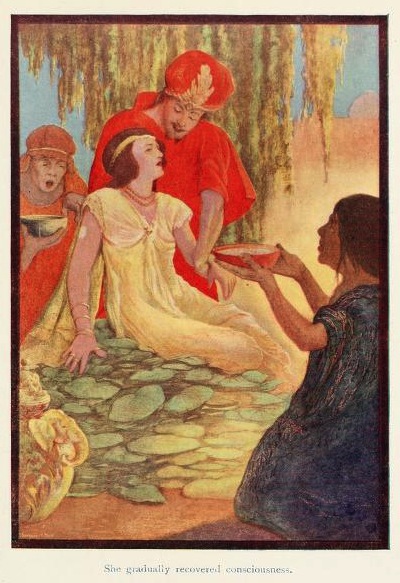
The second story is told using a framing device. While a king is traveling to see a monk, a goblin sitting on his shoulder entertains him with this story. There was once a king named Virtue-Banner who had three princesses as wives. Their names were Crescent, Star and Moon and the king loved them very much.
Illustrations by Perham W. Nahl (1917).
One day when the king was playing with Crescent’s hair, a lotus petal fell into her lap. She was so delicate that the petal wounded her and she fainted. Startled, the king sent for a servant and physician to attend to her.
Once he knew she was treated and comfortable, he went to be with his second wife, Star. While they slept that night, a moonbeam made its way through the window and landed on Star. She awoke crying that she had been burned. The king woke and saw the blisters across her body and summoned a servant and physician to treat her burns.
Meanwhile, the third wife, Moon, had left her room seeking the king. As she walked in the quiet night, she heard the sound of pestles grinding grain from a far off corner in the palace. She wrung her hands in agony and cried that the sound would kill her. The servants tended to her and found her hands were covered in bruises. When the king heard of this, he ordered a cooling plaster be made to ease her pain. The king sighed thinking that while his wives’ delicacy trait was a great virtue, it was also terribly inconvenient.
Then the story returns to the framing device of the goblin telling this story. He asks the king which wife was the most delicate, to which the king answers the third because she was hurt by something that was unseen.
More Tropes than in a NYT Bestseller!
There are many tropes that can be pulled from this story and many of them are quite comical. The first is the “Suddenly Suitable Suitor” trope. You know in a movie or book where the two main leads can’t be together because there is a power or class difference? Well, suddenly the lower raking one comes into money, or was a surprise Prince the whole time! We love suddenly suitable suitors in media like Game of Thrones, Sleeping Beauty, and every iteration of Cinderella- ever. It also leads to the iconic “now we can be together!” line.
The next one is the “Nobility Reveal” where a character accidentally reveals themselves as a member of the nobility or royal family by wearing something really expensive, not knowing how basic things work or any other visible or social indicator of wealth. Usually the noble thinks they are doing a good job hiding their true identity, but everyone around them usually knows the truth. Sorry Princess, maybe take the tiara and expensive dresses off before trying to pass for a peasant!
And finally, we have the “Honorary Princess” trope. We have no idea if the Princess in the story is truly a princess or not, just that she is delicate and sensitive However, the Queen and Prince take this as confirmation of her status and so she is considered every bit a Princess. While this trope is not as simple in other stories, there are still works like Mulan, Enchanted, Game of Thrones and The Princess Bride, where the ‘Princess’ character is honorary at best.


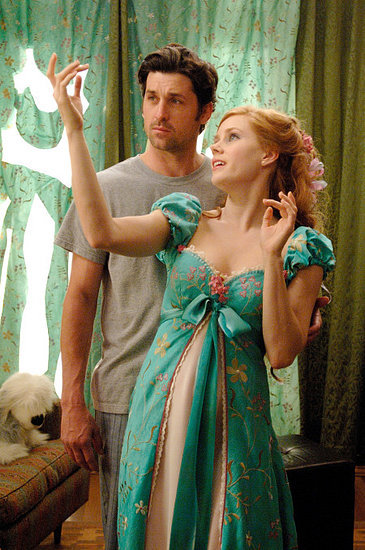
Examples include Gendry from ‘Game of Thrones’, Giselle and Robert Philip from ‘Enchanted’ and Princess Buttercup from ‘Princess Bride.’


 Tales from the Enchanted Forest