

What began with Egyptian funerary texts, hymns, poems and records soon evolved into one of the earliest records of narrative literature. There were few surviving narrative stories from the Middle Kingdom, including the “Story of Sinuhe,” and “Tale of the Shipwrecked Sailor.” Narrative tales like our Doomed Prince didn’t flourish as a genre till down the line in the New Kingdom!
“The Tale of the Doomed Prince” comes from an Egyptian Papyrus, which contains a series of love poems and two tales. The Papyrus, known as the Harris 500, is currently on exhibit at the British Museum after being donated by Semila Harris and her father, Anthony Charles Harris. Egyptologists have dated the text as originating in the 18th or 19th dynasty from the New Kingdom. To date these texts, researchers looked at the age of the paper and the themes used in the story. “The Tale of the Doomed Prince” is thematically closest to the tale of the “Two Brothers” on the D’Orbiney Papyrus from the 19th dynasty. The true mystery of this story is that the ending is missing! During an explosion in Selima Harris’ home in Alexandria, the papyrus was burnt and the ending was lost forever!
We have used a series of translations, retellings and articles to piece together a comprehensive summary of the text!
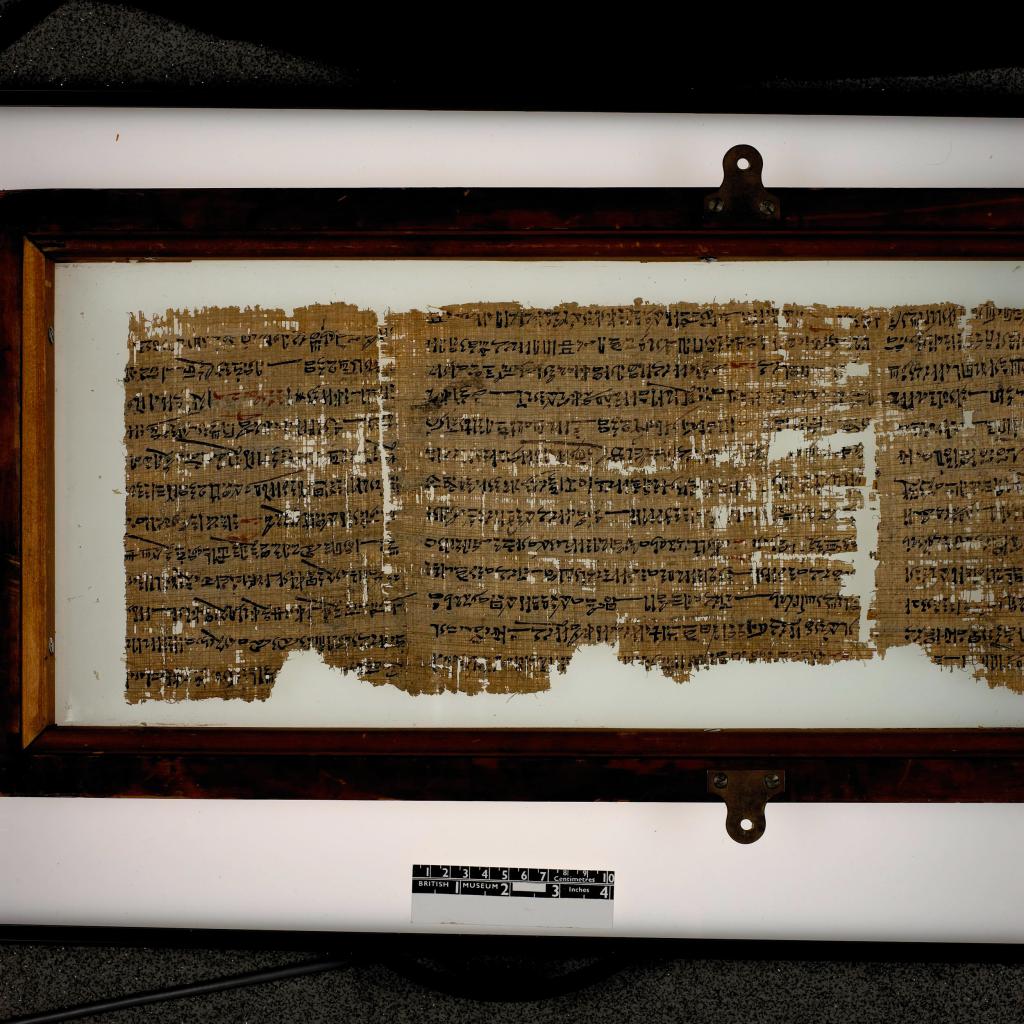
The HARRIS 500 Papyrus showing ‘The Doomed Prince’ (41.-8.14) as purchased from Selima Harris. © The Trustees of the British Museum. Shared under a Creative Commons Attribution-NonCommercial-ShareAlike 4.0 International (CC BY-NC-SA 4.0) licence.
The Birth of the Doomed Prince
There once was a King who was happy in all things, except for his desire for a son. Every night, he prayed until his wish was granted, and his wife gave birth to a healthy baby boy. However, when the Seven Hathors came to attend his birth, they foretold a terrible fate for the boy. They declared that the young Prince will die either by a crocodile, a serpent or a dog.
Hathor was the Goddess mother, which included the powers of fertility, childbirth, love, and beauty. She was the mistress of heaven and seen in the milky way. Sometimes, she took on the form of the “Seven Hathors” who were tellers of fate. They knew the fate of every child and the length of their lives. In some cases, her priests acted in the name of Hathor to tell fortunes and oracles. Overall, not the weirdest fairy godmothers to show up at birth.
Hearing this, the King had a house built on a mountain and filled it with everything his son could ever need. He sent his son there so that the boy would be safe from his fate. However, as children do, the boy climbed onto the roof one day and saw a man with a dog. Never having seen a dog before, the boy demanded one for himself. His father, wanting to give him everything he could, eventually relented and gave him a puppy as his faithful companion. The King gave the Prince a boar-hunting dog in line with Egyptian traditions, which saw dogs as working animals.
“The Doomed Prince” as retold and illustrated by the wildly talented Zaireeto who also has several other videos on Set and the Egyptian Gods.
The first fate we come across is related to the dog. These creatures were also the most suspicious as ill-omens because dogs were closely associated with death and the afterlife. Canines and canine-like deities were associated with Anubis, the original God of the Underworld and death. In the famous rebirth myth, Set’s wife, Nephthys tricks Osiris into sleeping with her.
Their union results in Anubis, who is abandoned and adopted by Isis shortly after. After Osiris is murdered and dismembered by Set, Isis turns to Anubis for aid. Anubis tends to the funeral rituals of Osiris and preserves him in the afterlife, making him the God of the afterworld. The subsequent celebration by Isis and Osiris leads to the birth of Horus. The Hathors probably saw this gift coming, and sadly, the Prince sealed his fate when he got the dog as a pet.
The Prince in the Cage
As time went on, the boy grew into a man. He could no longer bear being isolated from the rest of the world and became restless. He confronted his father, who dejectedly told his heedless son of his fate. Instead of being scared or reproached, the Prince scoffed and said that his fate would find him, regardless of where he hid.
In some translations, the King loves his son to a fault and allows him to do whatever makes him happy. In variations, however, there is the addition of an evil stepmother. These latter tales have the evil stepmother plotting to remove the Crown Prince, and she urges her husband to banish him from Egypt!
The Prince travelled with his dog and did anything he wanted- which was what he was doing anyway! One day, he came across the mention of the Chief of Nahairana, or Mesopotamia. This Chief had one daughter and loved her enough that he did not think anyone else was worthy of her. He built her a glass tower over 70 cubits off the ground! The Chief then sent out a bride quest to the Princes of Syria, where he promised his daughter’s hand in marriage to anyone able to climb up to the top of the tower.
When the Doomed Prince arrived in Nahairana, he was taken in with the other Princes and treated well.
In various tellings, the Prince lies and tells them that he was just the son of a simple officer from Egypt that had fled from his resentful stepmother. This could be the cause for the addition of the stepmother in the earlier section of several variants. In this retelling, it was a lie, but the kind princelings felt sorry for him and extended their hospitality.
The Princess in the Tower
The next day, the Prince watched as the other men attempted to climb up a glasshouse. When he asked what they were doing, they told him of the beautiful Princess in the tower. Anyone who could reach her would become her husband and the son-in-law of the Chief.
The Prince loved a challenge, so he prayed before beginning his climb. The text vaguely mentions enchantment and the aid of a God, but there is no consensus on how he was able to succeed. Either through spontaneous flying or climbing, he reached the Princess, who was excited to see her future husband and embraced him at once.
She had a letter sent to her father to inform him of her happy new husband! The Chief was also excited until he made inquiries about the successful youth and found out it was a fugitive from Egypt. He grew annoyed and decreed that the fugitive would be sent back to where he came from!
Now, the Princess did not appreciate her father’s reply. Not only was she locked in a high tower waiting for a strange man to climb up, but when one finally came up, her dad was also going to send him away?
She held onto the Prince and exclaimed that by Ra-Harakhti if anyone tried to take him from her, she would refuse to eat or drink, and in that hour, she would die! (In some cases, she prayed to Horus-the Sun God
The messengers alerted the Chief of his daughter’s threats, and he immediately planned to send an Assassin. The Princess, however, knew her dad was a temperamental man. She swore by the great Lord Ra that if her Prince died, then so would she.
The Chief had been uno reversed twice, so he decided to see who this youth was. He summoned both of them to meet him. When they entered, the Chief embraced the Prince in disguise. He asked who he was, and the Prince told the same story as before. He said that he was just the son of an Egyptian Officer who had to flee due to his bitter stepmother.
Happily Ever After?
The Chief decided to accept the youth and gave the couple his blessings, a house, slaves, lands, cattle, and all manner of expensive gifts to ensure his daughter’s happiness.
The couple lived happily for a while, and the Prince told his wife of his fate. She immediately suggested that they kill his dog, but the Prince was horrified and said he would not do that. His wife was not pleased but saw that there was no changing his mind, so she decided to stay diligent on his behalf.
The couple eventually got restless and decided to go travelling. At the first town they visited, a vicious crocodile confronted them, but fortunately, there was also a mighty giant known for capturing this specific crocodile. The giant appeared and caught the Crocodile with promises of keeping him far from the Prince, but warned that he could not kill it due to its sacred nature.

SMITE LORE episode 18 is all about Sobek as pictured above from the offical SMITE website.
Crocodiles had a lot of power in Ancient Egypt, and in the Old – Middle Kingdoms, there was the Crocidile-headed God, Sobek. In pyramid texts, he is a raging God who stole women but was also the one responsible for creating fertile lands near the river banks. Another prominent crocodile-headed deity was Ammit, a demoness who devoured those whose hearts were found impure during the heart ceremony.
In the story of Peter Pan, we also have a crocodile representing impending death. His arrival is always announced by the ticking sound of a clock, signalling the end of time.
The Prince and his Wife rested easily, knowing that the Giant was in charge of the crocodile, and they continued to enjoy their trip in the village.
Every day, the mighty Giant left his house and returned when the sun was high so that he never lost his shadow. During his daily outings, the crocodile would plot and plan his escape.
It seems that there are some translation issues here. Across various texts, there is mention of a Giant and his shadow, but we are lacking the cultural knowledge to know why. There are superstitions based on the hyena and how it could paralyze a man just by stepping on his shadow. Other regions believed you needed to avoid the shadowless hour of high noon since certain demons did not cast a shadow, and you could not tell creature from man.
Back to our leading couple: one night, the man fell asleep on the couch, and his wife stayed by his side. She placed a bowl of milk next to him and kept watch. Eventually, a snake slid into the open and made to bite the man, but the wife had the servants grab it and feed it the milk until the snake was full and helpless. She then grabbed a knife and killed it. When her husband woke up, she declared that the Gods had given her one of his dooms and would surely give her the others. They prayed together and sacrificed to the Gods.
In Ancient Egypt, the snake is associated with Kings and destruction. Egyptian pharaohs wore a headdress called the Uraeus, which had a gold cobra on the temple. This was a sign to the Goddess Wadjet, the protector of Pharaohs and their divine powers. However, the original snake from Egyptian mythology was Nehebkau, an eternal god and demon that eats souls in the afterlife. In the Coffin texts, another God, Atum helped calm Nehebkau’s chaotic nature.
Furthermore, contrary to popular belief, Snakes don’t actually like milk. They will drink it if they are desperate and dehydrated, but they don’t prefer it. This myth came from anecdotes from archeologists who claimed they trapped snakes with bowls of milk around dig sites.
Later, as the Prince and his dog were walking across his fields, the dog began chasing something. The Prince followed him, and they both ran into the river where the escaped Crocodile was hiding. Out of nowhere, the Crocodile launched himself at the Prince! He managed to grab hold of the Prince, and as he carried him, he said, “Behold, I am thy doom!”
Cliffhanger
This is where the papyrus is burnt and no longer legible so we have no idea what occurred to the Prince! It is quite likely that the doomed Prince survived his fate and was saved by his diligent wife. It could also be that the King seals the Prince’s fate the moment he gives him the dog! What do you think?
Does our fearless Prince die? Or does the faithful wife rescue him from all the fates? It is difficult to determine what direction this story will take. In the story of the Two Brothers, the predictions of the Hathors come to pass. We can always hope that another copy of the story can be found and give us a clue as to the ending! I want to call it a cliffhanger, but cliffhangers occur a moment after a twist is revealed, or when the characters are in great peril. They are also intentional stopping points placed by the author before things get resolved in another part of the story. In this case, we are just left hanging.

1. Gilded Cage
Besides being royalty, both the Prince and the Princess have one thing in common; both had fathers who created places for them, places they were never supposed to leave. The gilded cage trope is when a character lives in a fantastic home that meets their every possible want and need, but they can never leave it. This trope often demonstrates that the character values their liberty above comfort when they inevitably break free of their luxurious prison.
Some stories that use this trope at different points are Beauty and the Beast, Avatar the Last Airbender (Toph), Hunger Games (Tributes before the games) and East of the Sun and West of the Moon (we covered the latter recently, so check it out here). We also see this used against Demigods or ‘heroes’ who need to be protected, such as Hiku, Achilles, and Jason.
Often stories that feature this trope only focus on it for a short time in the story. After all, the best part of these stories is seeing characters break free and face the consequences of living on their own. However, if you want to see a movie that is all about acknowledging and escaping a gilded cage, look no further than The Truman Show. This movie focuses on Jim Carry’s character, Truman Burbank, whose entire life was subtly directed for a television show. Does this make him the first reality TV star?
2. Selima Harris
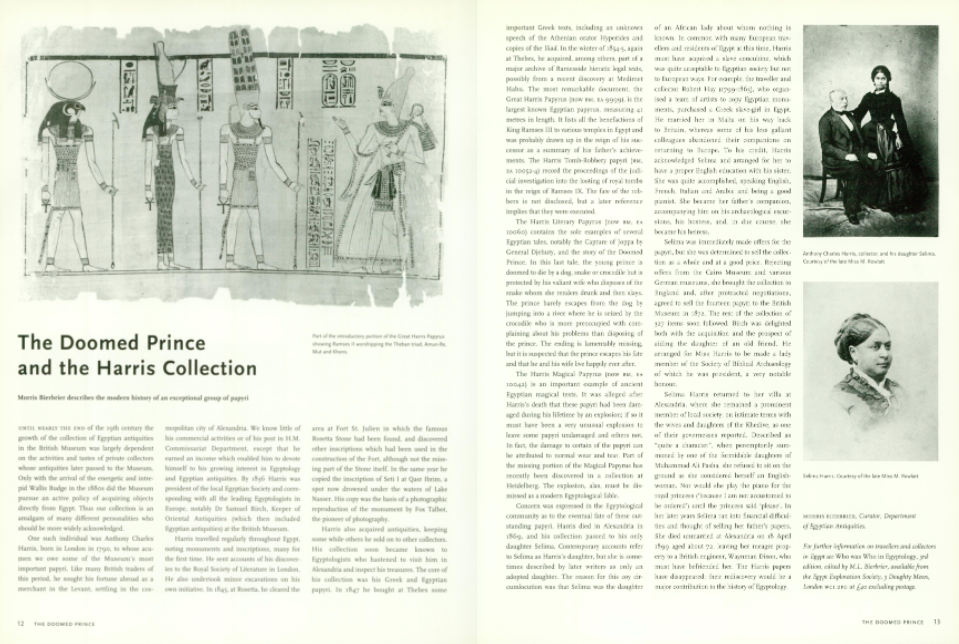
I will be the first to admit that I enjoy going down rabbit holes when I am researching. This episode was no exception, and I was caught in a historical revelation fuelled by Historian Amara Thornton! The Harris 500 Papyrus was donated by Selima Harris, who is listed on the British Museum’s website as the donor of her adopted father’s collection, the Egyptologist, Anthony C. Harris. However, in a Magazine article by the British Museum, Morris L. Bierbrier, Asst. Keeper of the Egyptian Antiquities at the British Museum wrote that Selima was often listed as his ‘adopted daughter’ since her mother was an “African lady about whom nothing was known.”
For Harris’ part, he openly claimed Selma as his daughter and remarked in a letter dated June 21st, that he had hired an American photographer by the name of Mr. Greene to teach his daughter photography for their next voyage in November. He also had her sent to Britain for her formal education, and Selima Harris was quite exceptional in her own right. Her photographs were used during the Syro-Egyptian historian meetings, she was a friend and regular correspondent with Florence Nightingale, and she was a Lady member of the Society of Biblical Archeology. In his article, “The Crocodile Pit of Maabdeh, Florence Nightingale, and the British Museum’s Acquisition of the Harris Homers,” Brent Nongbri details two letters from Nightingale where she claims Selima was the true discoverer of the codex.
3. Papyrus
This story was recorded on papyrus. What is papyrus you ask? Besides being the font for James Cameron’s Avatar, it is also a plant and the name for the thick parchment material made from the plant of the same name. This material is best known for being made and used in Egypt. While it was used as paper for recording stories and official documents, the material was hardy enough to be fashioned into saddles, baskets and even boats.
To make papyrus paper, you would first harvest the plant. The ancient Egyptians would have used the Cyperus papyrus plant, which looks like a tall green reed between 4-and 5m high. The outer green layer can be removed and often repurposed for basket weaving. Then the inner white part, also known as the pith, would be chopped into long strips. These strips would then be soaked for a few days before being taken out and placed side by side, with a slight overlap. Another layer of papyrus strips would go on top. Next, pressure would be applied to squeeze all remaining liquid out of the paper. After a few days, the paper would be placed under the sun to dry out. Then, the papyrus would be smooth and ready to be used.
4. Prophecy and Egypt
The idea of fate and prophecy are seen repeatedly in Egyptian works as early as the 6th Dynasty and probably existed beforehand. In the Instruction of Ptahhotep, it says, “His time does not fail to come; one does not escape what is fated.” So it seems likely that the Prince in our story will meet his fate. The precedent we have to go on comes from The Tale of the Two Brothers which also came from the 19th Dynasty. The God, Khnum, makes the younger brother, Bata, a wife and the Hathors that are present determine that she will die by knife, which she eventually does.
It was rarely thought that anyone could escape their fate or destiny, and yet protection amulets and rituals existed. These charms were likely used to circumvent bad omens, curses, or bad favour. The scholarship around the Doomed Prince’s outcome varies, with some scholars arguing that his wife will be his protector and others arguing for the foreshadowing with the dog.
5. Man’s Best friend

While today it seems normal, historically, it was strange and rather interesting that the Prince wanted a dog as his companion. Up until the 18th or 19th century, the attitude towards our canine friends was negative. Before the 19th century, dogs fulfilled a functional purpose in hunting but were otherwise seen to be dirty, disease-ridden and of little worth. Of course, this excludes lapdogs who were so small that they were never used for hunting.
The phrase referring to dogs as a “Man’s best friend” was first recorded as being said by Fredrick the Great of Prussia in 1789. He said, “The only, absolute and best friend that a man has, in this selfish world, the only one that will not betray or deny him, is his DOG.” I’m not sure how well that worked out for our Prince today, but we get the drift.
One possible reason for the rise in popularity of having a canine companion is the discovery of the rabies vaccine in 1869. Knowing that your lovable, furry friend wasn’t going to accidentally give you a deadly disease, is quite comforting.




 Tales from the Enchanted Forest